
After-Hours Call Capture: The Hidden Revenue Leak in Service Businesses
Service businesses lose more revenue between 5pm and 9am than during business hours. Here's how after-hours call capture works, why it's the highest-ROI AI deployment for SMBs, and how to set it up in under a week.
INTRODUCTION
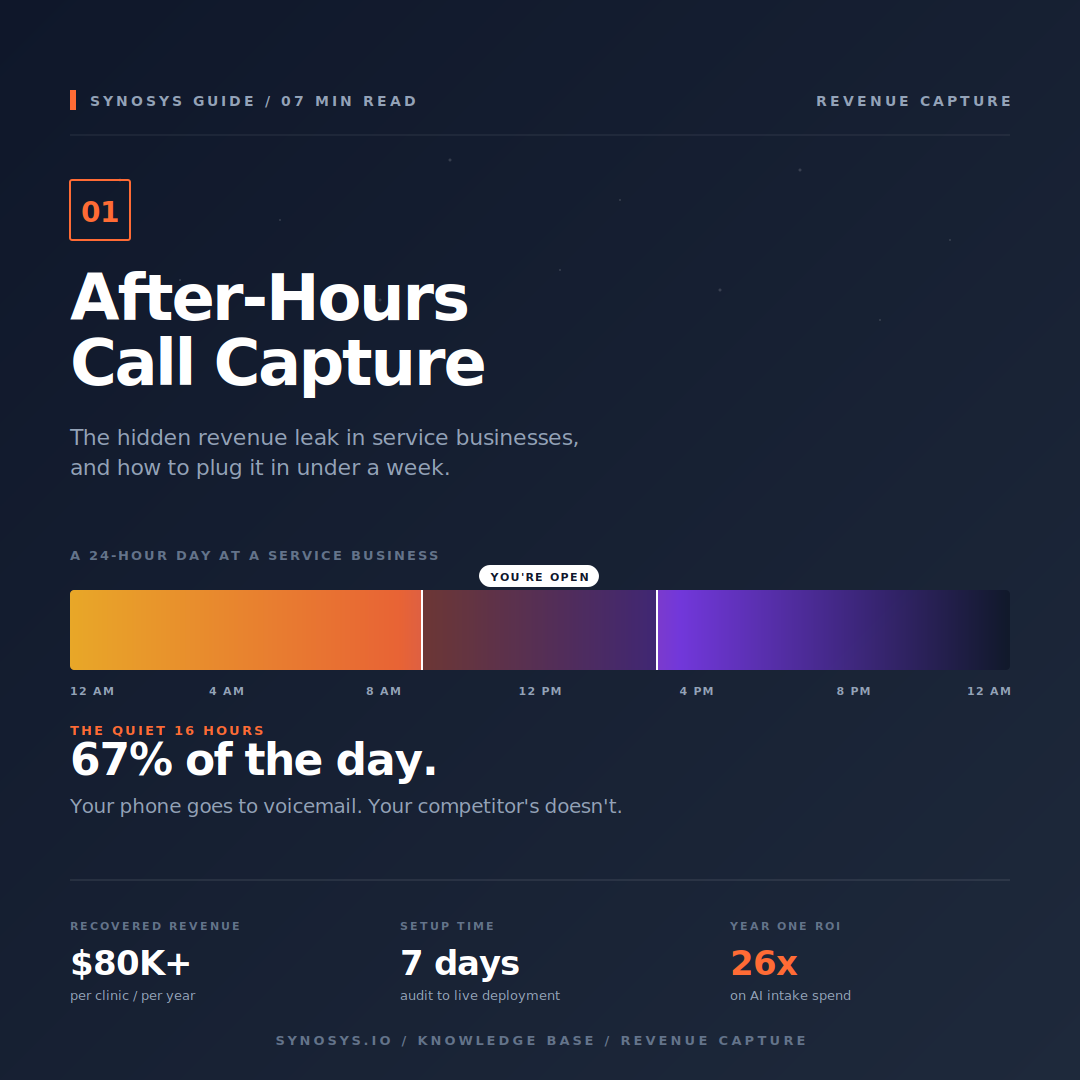
Most service business owners think their revenue leak happens during business hours. Wrong window. The biggest leak happens between 5pm Friday and 9am Monday, when the phone rings and nobody picks up.
Industry data from 2026 puts the average small business missed call rate at 62 percent. A large share of those calls happen outside business hours. For service businesses where each new client is worth thousands or tens of thousands in lifetime value, that window is the single most expensive blind spot in the operation.
This article breaks down what after-hours call capture actually is, why it outperforms every other AI deployment in ROI terms for SMBs, and how to set up a working system in under a week.
WHAT IS AFTER-HOURS CALL CAPTURE
After-hours call capture is the practice of routing inbound calls that arrive outside business hours to an AI intake system that answers, qualifies, and either books the appointment or captures the lead with full context.
It is not voicemail. Voicemail is a passive system. It tells the caller you'll get back to them later. About 85 percent of callers who hit voicemail at a service business never call back. They go to the next listing.
After-hours call capture is active. The caller has a real conversation, gets their question answered, and books a slot or gets a callback scheduled. Same outcome as a human receptionist, just at 11pm.
WHY IT'S THE HIGHEST-ROI AI DEPLOYMENT FOR SERVICE BUSINESSES
Three reasons.
First, the volume is concentrated. Most after-hours calls are genuine inquiries, not spam or vendor calls. Spam tends to come during business hours. The person calling your dental clinic at 8pm has tooth pain and is shopping for the next morning's appointment.
Second, the conversion intent is high. Someone calling outside business hours is usually motivated. They've decided they need the service. They're picking who to call.
Third, the cost is low. AI voice agents for SMBs run $50 to $300 a month for full coverage. Compared to recovering even a single client per month, the math is rarely a question.
A clinic in our network tracked this directly. Before deploying after-hours capture, they were losing roughly two new patients per week to the post-5pm voicemail. After deployment, they recovered most of that volume. Annual recovered revenue: above $80,000. Annual cost of the AI intake layer: under $3,000.
That's a 26x return in year one. There aren't many other investments inside a small clinic that compete with that.
HOW IT ACTUALLY WORKS
The system has four components. Each one matters.
Phone forwarding. After business hours, your main line forwards to the AI intake number. This is a one-time setup with your phone provider. Most VoIP systems support time-based forwarding out of the box.
Voice agent. An AI receptionist trained on your business. It knows your services, your hours, your booking rules, your emergency triage protocol. It speaks naturally, understands accents, and handles interruptions. Modern voice agents resolve 90 to 95 percent of calls without human handoff.
Calendar integration. The agent connects directly to your booking system. Google Calendar, Calendly, or your practice management software. When the caller asks for Tuesday at 2pm, the agent checks availability in real time and books it.
Logging and handoff. Every call gets transcribed, summarized, and logged into your CRM. Urgent matters get routed to your phone immediately. Routine bookings show up in your inbox the next morning, fully qualified.
That's the full loop. No human required for the typical call. You read a summary in the morning instead of returning 12 voicemails.
THE FOUR INDUSTRIES WHERE THIS PAYS BACK FASTEST
Dental and medical clinics. Patients call when pain hits. Pain hits at night. Average new patient value: $2,000 to $5,000 first year, much higher lifetime. One recovered patient per month covers the AI cost for a full year.
Law firms. Most legal inquiries come from people in active distress. A car accident. A divorce filing. A business dispute. They're calling between phone calls and panic. If you don't answer, they call the next firm. Average matter value runs $5,000 to $50,000.
Real estate. Buyers and sellers call when they see a listing. They see listings on Sunday afternoons and Tuesday evenings. If your line goes to voicemail, they call the next agent on the listing site. A single recovered transaction usually pays for ten years of AI intake.
Home services. Emergencies happen at night and on weekends. HVAC, plumbing, locksmith, electrical. The provider who answers gets the job. Industry data shows home services miss 60 to 80 percent of calls. Recovering even half is transformational.
SETUP TIMELINE: ONE WEEK
Day 1. Audit. Pull your last 30 days of call logs. Count missed calls by time of day. Calculate your average client lifetime value. Multiply. That number is your baseline.
Days 2 and 3. Configure. Set up the AI voice agent with your business details, services, hours, FAQs, and triage rules. Connect it to your calendar and CRM.
Day 4. Test. Call it yourself. Have three colleagues call it. Stress test the edge cases. Tweak the prompts.
Day 5. Soft launch. Forward only after-hours calls for a week. Review every transcript daily. Refine.
Day 8 onward. Run. Review weekly summaries. Track recovered appointments. Compare to the baseline you calculated in Day 1.
Most SMBs are live and recovering revenue inside ten days from the moment they decide to do it.
COMMON OBJECTIONS, HONESTLY ANSWERED
"My clients want to talk to a human." A small percentage do. Most just want their question answered and their slot booked. The AI handles the routine 90 percent and routes the unusual 10 percent to you. Your callers are not a uniform group. Treat them like they aren't.
"It will sound robotic." Voice quality in 2026 is not what it was in 2022. Modern systems pause naturally, handle interruptions, and adjust tone. Most callers don't notice. The ones who do mostly don't mind, because the call is solving their problem.
"I'm worried about errors." Errors happen. Humans make them too, just differently. The right setup includes a daily review of summaries for the first month. After that, the error rate is well below what a tired front desk produces at 4:55pm.
WHAT TO DO THIS WEEK
Pull your call log. Count the after-hours calls from the last 30 days. Multiply by your average client value. The number will tell you whether this is a $20,000 problem or a $200,000 problem.
Then decide.