
The 5-Figure Gap Between "Patient Registered" and "Patient Booked"
Multi-therapist clinics quietly lose 15 to 30 percent of new patient revenue to a gap their booking software was never built to show. Here is the fix.
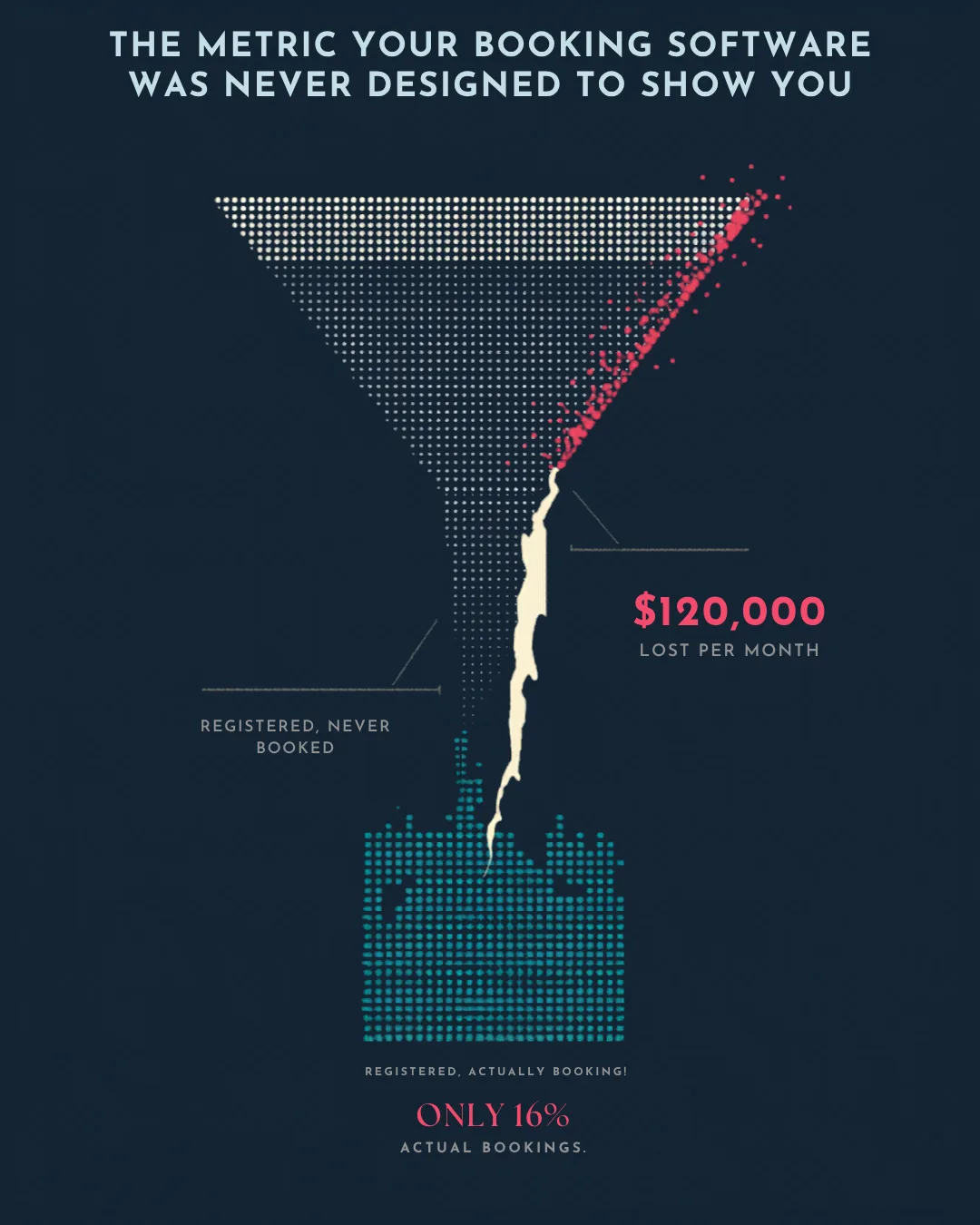
The invisible revenue leak hiding inside every multi-therapist clinic.
The Metric Nobody on Your Team Is Watching
Every clinic owner can tell you their booking count last month.
Almost none can tell you their registration count.
The difference between those two numbers is the most expensive metric in your business, and your booking software was not designed to show it to you.
A patient lands on your site. They start a new patient registration. They fill out demographics, insurance details, condition information. They click submit. The form goes through. They are now in your system as a registered patient.
Then they leave the page.
They never select a time. They never confirm an appointment. They never become a booking.
If you only measure bookings, you will never know they were there. But they were there. They wanted help. And then something between registration and booking caused them to leave, and you have no idea what it was.
That gap is the leak.
How Big Is It?
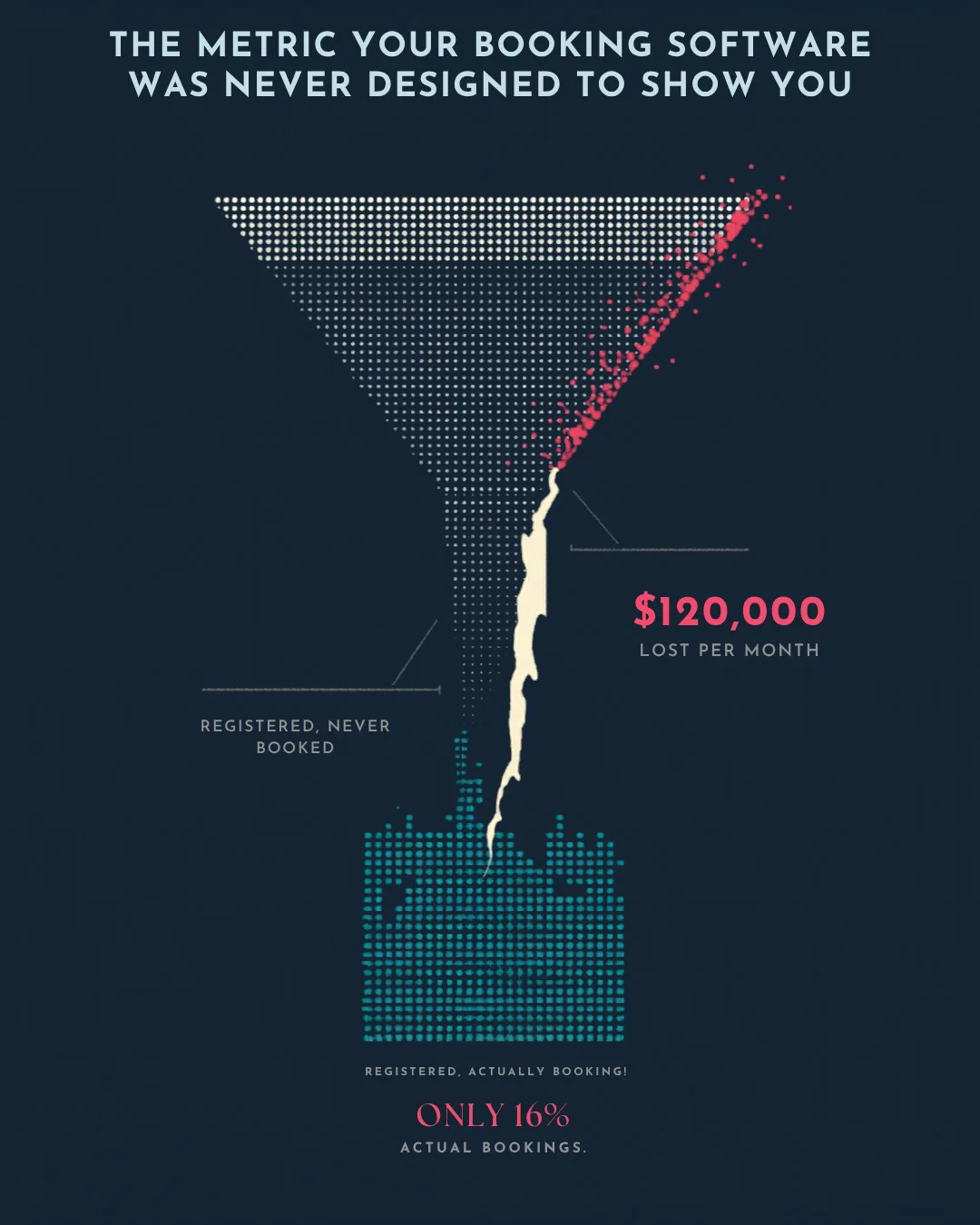
Industry data from 2026 puts the gap at 15 to 30 percent of new patient inquiries across primary care and allied health clinics. The exact rate depends on specialty, booking platform, and intake design, but the range holds across studies.
Let us run the math on a real-world example.
A 70-therapist multi-discipline clinic in Ontario handles roughly 1,200 new patient inquiries per month between phone, web form, and after-hours channels. With an average new patient lifetime value of $400 to $800 across initial visit plus follow-up care, the math looks like this:
That number gets larger if you include the downstream effects. A registered patient who did not book also did not refer family members. They did not become a Google review. They did not return for a second condition six months later.
A 5 percent improvement on this metric for the same clinic is worth $30,000 per month in recovered revenue. The interventions that close the gap cost a small fraction of that.
Why More Reminders Do Not Fix It
The instinct most clinic owners reach for first is: send more reminders.
This does not work, and it does not work for a specific reason.
Reminders solve the problem of a booked patient forgetting their appointment. Reminders work on no-shows. They reduce missed appointments by 15 to 25 percent in most studies.
But a registered-not-booked patient does not have an appointment to forget. They never made one. Sending them a reminder about an appointment they never booked is, at best, awkward. At worst, it nudges them to write you off entirely.
What this patient needs is a different intervention. They need a human or AI-driven follow-up within minutes of their registration that asks them what stopped them from booking and offers to help them book in real time.
The data on this is clear. The Harvard Business Review's lead response study found that the odds of qualifying a lead drop by 80 percent after the first five minutes of inquiry. The same dynamic applies in clinical intake. The longer you wait to follow up with a registered-not-booked patient, the lower the conversion rate.
In most clinics, that follow-up never happens at all.
The Architectural Fix: Capture Before the Platform

This architecture has three properties worth naming.
It does not require switching booking platforms. The thin layer sits above whatever booking software you already use. It does not require API access in most cases, depending on how your intake forms are structured.
It does not require a human to add headcount. The AI follow-up runs 24/7 and handles the first conversation. Humans only intervene on flagged escalations.
It does not require the patient to know anything about AI. The patient experience is a friendly follow-up message that acknowledges their interest and offers help. From their perspective, the clinic just got back to them fast.
The 4-Step Diagnostic You Can Run This Week
You do not need to buy anything to find your own gap. Here is the diagnostic.
Step 1: Count your registrations
For the past 30 days, pull a count of every new patient registration that landed in your system. Include phone-based registrations (intake notes), web form submissions, and any after-hours capture you have.
This is your top-of-funnel number.
Step 2: Count your bookings from new patients
For the same 30 days, pull a count of new patient first appointments. Make sure you are counting first appointments only, not returning patients.
This is your bottom-of-funnel number.
Step 3: Compute the gap
Divide step 2 by step 1. Subtract from 1. That is your registered-not-booked rate.
If your number is under 10 percent, you are operating at the top of the industry. Most clinics are between 15 and 30 percent.
Step 4: Sample five lost patients and call them
This is the step most clinics skip. Pull a list of 5 registrations from the past 30 days that did not convert to a booking. Call them. Ask one question: what stopped you from booking?
Each of those is a fixable intervention. Each of those, fixed, recovers 3 to 7 percent of your gap.
What This Looks Like in Practice
The clinic in the example above is currently 4 weeks into closing this gap. Their architecture lives between their intake forms and their booking platform. Three AI voice agents, one shared persona, handle all inbound calls under a single voice the patients recognize.
When a patient registers without booking, the system flags them within 3 minutes. An AI follow-up message goes out within 5. The message offers two specific time slots based on calendar availability, and asks the patient one open-ended question about what brought them in.
Closed-loop conversion rate is being measured as a first-class metric for the first time.
Phase 1 data will be reportable in late July. The expected outcome is a 5 to 10 percent recovery against the baseline gap. At the clinic's scale, that is between $30,000 and $60,000 per month in recovered revenue.
The build does not require the clinic to switch booking platforms. It does not require headcount. It does not require their patients to know any AI is involved.
It just closes a leak that was always there.
What You Can Do Right Now
If you are running a multi-therapist clinic and have not measured your registered-not-booked rate, that is the first place to start.
If you have measured it, and you are above 15 percent, the architecture above is the play. You can build it yourself if you have engineering capacity. You can hire someone to build it. Or you can let it keep running and accept the leak.
What you should not do is keep measuring only your bookings. That number tells you nothing about the patients you almost had.
Want a 30-minute audit of your clinic's intake funnel?
I run free audits for multi-therapist clinics in healthcare. No pitch, no slides. We look at your registration data, your booking data, the gap between them, and where the 3 to 7 percent recovery opportunities live for your specific operation.
Book here