
The Revenue You Can't See
Most service businesses can tell you last month's revenue, but not how many inquiries they missed. That silent number is usually the most expensive problem in the business. Here is the three-leak framework we use when auditing service firms, plus a free five-day diagnostic you can run this week without any software.
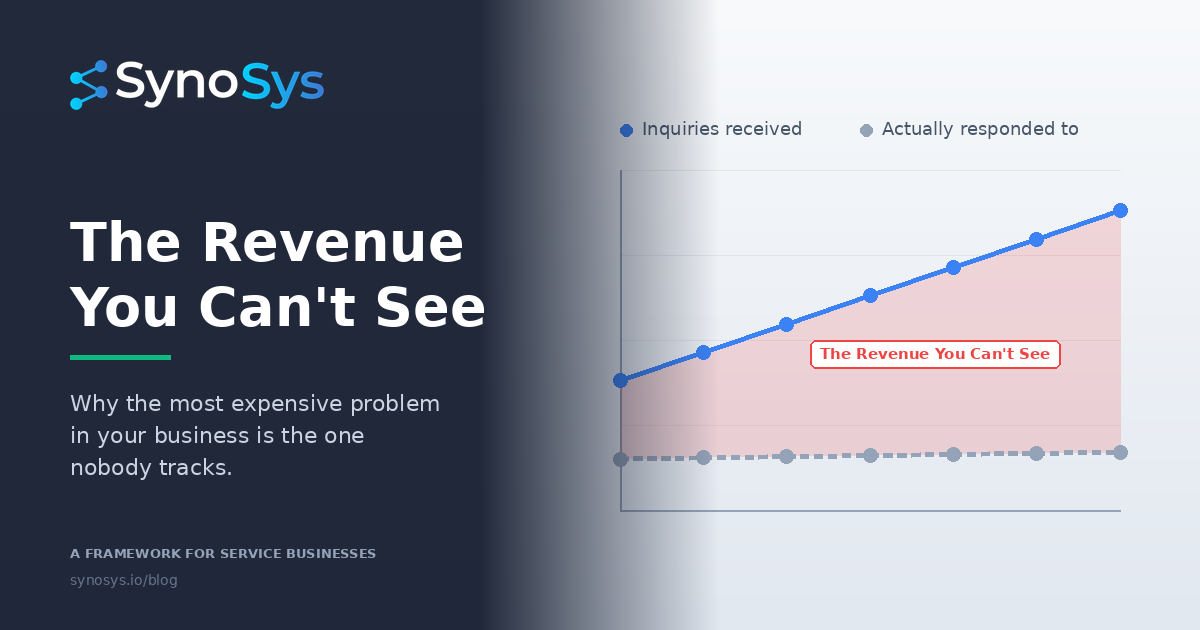
Most business owners can tell you their revenue last month. They can tell you their biggest customer, their best salesperson, and their slowest month of the year. Ask them how many inquiries they missed last week, and the room goes quiet.
That silence is the most expensive number in your business.
For service firms, especially the ones built on phone and form inquiries, the gap between "leads we received" and "leads we actually responded to" is where the majority of lost revenue lives. It is invisible on your P&L. It is invisible in your CRM. It is invisible in your team's weekly check-ins. And because nothing tracks it, nothing fixes it.
This piece is a framework for thinking about that gap. Not a pitch, not a product walkthrough. Just the lens we use when we look at service businesses, and the questions every owner should be asking whether they ever work with us or not.
The three places revenue leaks out
When we audit a service business for the first time, we look at three specific moments where inquiries disappear. These are not technology failures. They are process gaps that exist in almost every business we have seen, regardless of size or industry.
Leak one: the after-hours window
A significant percentage of new inquiries come in outside of business hours. For law firms, it is late evenings and Sunday mornings when people stop pretending their problem will go away on its own. For clinics, it is weekday evenings when parents finally have a moment to book. For real estate, it is any time someone is looking at their phone instead of their laptop.
Most businesses send these inquiries to voicemail, a contact form, or a chat widget that nobody monitors. By the time the team logs in Monday morning, a meaningful number of those people have already called the next firm on the Google results page.
The uncomfortable part: these are often the highest-intent inquiries. Someone who reaches out at 9pm on a Wednesday is usually dealing with a real problem. They are not shopping. They are looking for the first competent response.
Leak two: the peak-hour pileup
Between 10am and 2pm, and again between 4pm and 6pm, most service businesses experience a call volume surge that their front desk was not built for. Existing clients are asking questions, appointments are arriving, operations are running, and the phone keeps ringing. At some point, calls roll to voicemail. Forms get logged for "later." Inquiries sit in an inbox that nobody has time to process until tomorrow.
The team is not failing. They are triaging. And triage usually means the known client gets served and the unknown inquiry gets deferred. That is the rational choice in the moment. It is also expensive over time.
Leak three: the slow follow-up
The research on lead response time has been settled for over a decade. The faster a business responds to a new inquiry, the higher the chance that inquiry becomes a client. The effect is significant and it drops off fast. Responding in five minutes versus fifty minutes is not a small optimization. It is often the difference between winning and losing the client.
Most service businesses we see have a response time measured in hours, sometimes in days. It is not because the team is lazy. It is because the intake process was not designed for speed. It was designed to get to every inquiry eventually, which is a completely different goal.
The question most owners never ask
Here is the question we wish every service business owner would sit with for ten minutes this week:
If I knew exactly how many inquiries my business missed last month, would I change anything about how we operate?
Most owners guess the answer is no because they assume the number is small. Then we run the audit and the number is usually three to ten times higher than they expected. At that point, the honest answer changes.
The problem is not that owners do not care. The problem is that the number is invisible, and invisible problems do not get solved. You cannot track what you cannot see, and you cannot fix what you cannot track.
A simple diagnostic you can run this week
You do not need software to start. You do not need consultants. You need one week of observation and a notepad.
For the next five business days, have your front desk or intake team log every inquiry that comes in: the channel (phone, form, walk-in, referral), the time it arrived, the time someone responded, and whether a conversation actually happened. No editorial, no commentary. Just the raw numbers.
At the end of the week, look at three specific patterns:
Pattern one: How many inquiries arrived outside of business hours, and what happened to them? If your answer is "they went to voicemail and we called back Monday," circle that number. It is the minimum size of your after-hours leak.
Pattern two: What was your average response time during peak windows (10am to 2pm, 4pm to 6pm)? If it is over thirty minutes, you are losing inquiries you do not know about. Your team is doing triage, not intake.
Pattern three: How many inquiries never received a response at all? Not "called back once." Not "left a voicemail." Actually connected with a human. If the percentage is higher than you are comfortable with, you now have a number to work with.
This exercise takes about ten minutes a day to log and thirty minutes at the end of the week to review. Most businesses have never done it. Most are shocked by what it reveals.
What you do with the numbers is up to you
Once you know the real shape of your intake, you have options. Some businesses solve it by hiring. Some solve it with better training on the existing team. Some solve it with a scheduling tool. Some solve it with an AI voice system (which is what we build, but it is not the only answer and it is not always the right answer).
The specific solution matters less than the fact that you now have a number. A business that knows it is losing fifty inquiries a month can make a rational decision about how much to spend fixing the problem. A business that has no idea cannot make any decision at all. It just keeps leaking.
The part most people miss
The reason this matters so much is that fixing the intake leak is almost always cheaper than the alternatives every growing business reaches for.
Most service firms, when revenue flatlines, reach for more marketing. More ads, more content, more SEO, more referral programs. All of that works. All of it is expensive. And all of it pours more inquiries into the same leaky bucket.
Fixing the bucket first is the most underrated growth lever in service businesses. It does not cost more. It makes the existing marketing work harder. And it usually pays for itself within a quarter because the inquiries you are currently losing are inquiries you already paid to generate.
That is the lens we use when we audit a business. Not "how do we get more leads" but "how much of what you are already generating are you actually capturing, and what would it take to capture more."
That single reframe changes the conversation every time.
Where to start
If this piece resonates and you want to measure your own intake leak, the diagnostic above is free and takes one week. That is the honest starting point. No phone call with us required.
If you run the diagnostic and the numbers are worse than you expected, we do audits. Twenty minutes, no commitment. We walk you through your current process and show you where revenue is likely leaking. We will tell you if an AI intake system would help. We will also tell you if it would not. Both happen.
The only thing we will not do is pretend the problem does not exist. It does. For most service businesses we see, it is the single biggest constraint on growth that nobody is talking about.
Start with the number. The rest follows from there.
Synosys builds AI-powered intake and revenue capture systems for professional service firms. We work with law firms, clinics, real estate brokerages, and multi-location healthcare networks across Ontario and the GTA. If you want to see what a capture audit looks like for your specific business, book a free twenty-minute call. No commitment, no sales pressure. Just a conversation about what is leaking and what is worth fixing.