
Voice and Chat Intake Architecture
The full Synosys blueprint for AI voice and chat intake. How service businesses use one architecture to greet, qualify, route, and book every inbound caller, 24/7, without adding headcount.
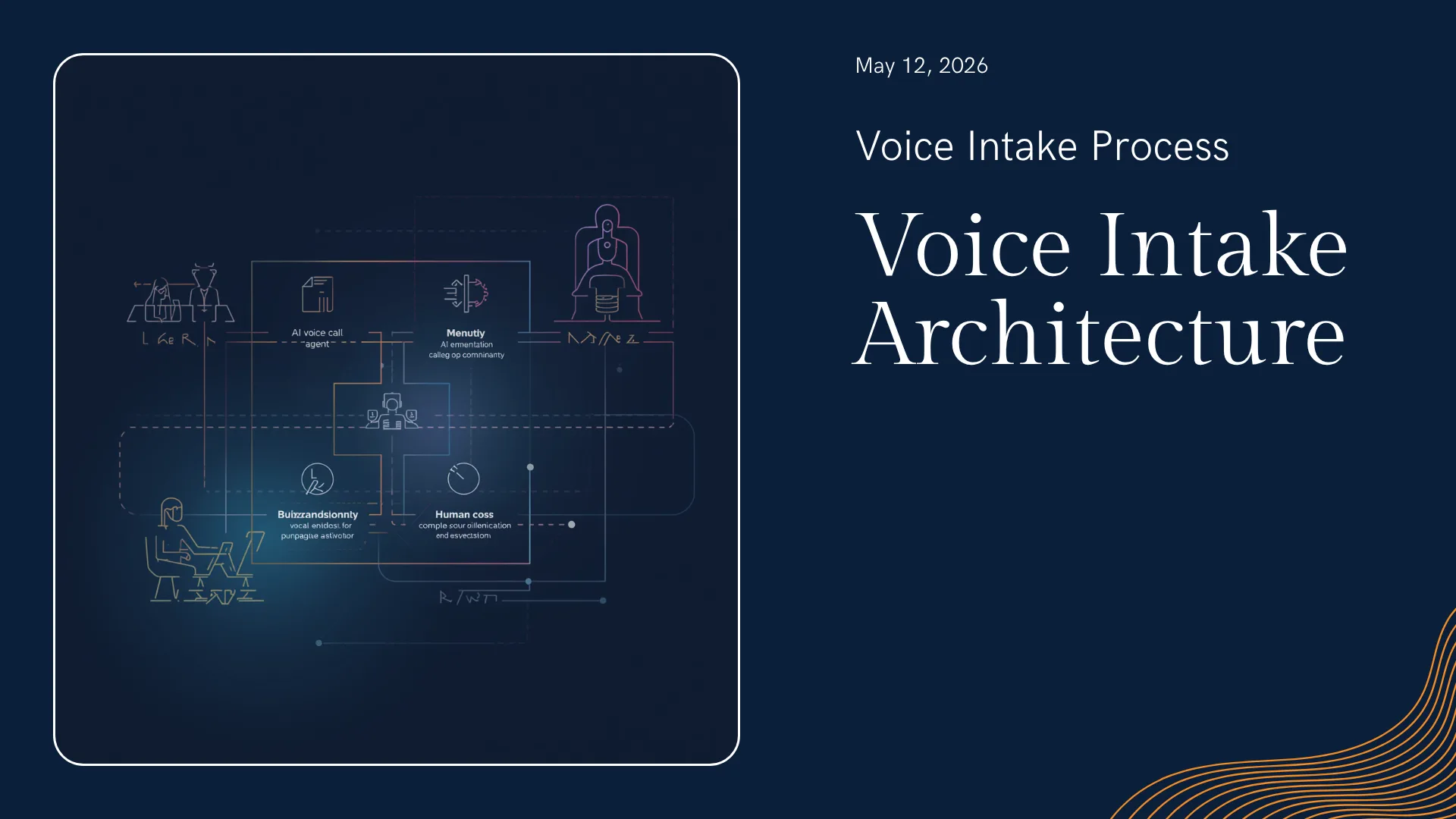
The five-stage Synosys voice and chat intake architecture.
The problem nobody books a call about
Clinics, law firms, and high-trust service businesses do not have a marketing problem. They have an intake problem. The phone rings during a procedure. The chat box pings at 9:47 PM. A new patient form gets half-filled and abandoned. By Friday, somebody on staff is still trying to figure out which voicemails got returned and which ones quietly walked across the street.
The cost is invisible because it does not show up in any single report. It shows up as flat new-patient growth, as therapists with empty Tuesday slots, as a clinic that has to de-roster the patients it cannot follow up with. It shows up as a law firm where two thirds of inbound leads never get a callback inside 24 hours.
Most owners try to fix this with more people. More headcount, more shifts, more after-hours coverage. The math runs out fast. The real fix is architectural, not staffing-based.
What "intake architecture" actually means
An intake architecture is the path an inbound lead travels from first signal to booked appointment. The path has stages, and each stage has a job. When the path has gaps, leads fall through them. When the path is continuous, the business compounds.
The Synosys voice and chat intake architecture has five stages. Each stage is a specific job, owned by a specific component, with a specific output that feeds the next stage. There is no human in the loop until the architecture says one is needed.
The five-stage architecture
Inbound capture
Every inbound signal hits the system. Phone calls go through a dedicated number that routes to the AI voice agent. Chat lives on the website and on Google Business Profile. SMS, web form, and Facebook messages all funnel in. Nothing is dropped, nothing waits for business hours.
AI voice and chat agent
The agent greets the caller or visitor in natural conversation, identifies intent, and captures the data the business needs. For a clinic, that is name, reason for visit, urgency, insurance, and preferred provider. For a law firm, that is matter type, jurisdiction, conflict-check inputs, and timeline. The agent is built on a real LLM, not a decision tree, so it handles interruptions, accents, callbacks, and the messy way humans actually talk.
Qualification and routing logic
This is the brain. Every captured conversation is scored against the business's qualification rules. High-urgency cases get escalated immediately. Existing patients route to recall workflows. New leads route to intake. Out-of-scope inquiries get a polite handoff and a logged record. The rules are not buried in code, they are visible, editable, and owned by the operator.
CRM and calendar sync
Once qualified, the lead is written to the system of record in real time. The agent checks availability against the live calendar, books the slot, sends the confirmation, and adds the contact to the right pipeline stage with the full transcript attached. No double entry, no Monday-morning data cleanup, no "we'll add you to the system later."
Human handoff
The architecture is opinionated about when a human is involved. Routine bookings never need one. Edge cases, high-value leads, and explicit "I want to speak to a person" requests get a warm transfer or an instant SMS summary to the right team member, with the conversation transcript already in hand. Staff get fewer calls and better-prepared ones.
The escalation rule set is the moat
Most AI intake tools fail at the same place. They sound great in a demo and crumble the first time a real edge case shows up. A patient mentions chest pain. A caller is in distress. A prospect drops a competitor's name. A regulator asks a question.
The Synosys architecture solves this with an explicit escalation rule set. Every deployment ships with a documented set of triggers that override the conversational flow and route the caller to a human, with context attached, inside a defined SLA. The rule set is reviewed with the client during onboarding and revisited every quarter. It is not a black box.
What the operator sees
The whole system reports to one dashboard. Calls handled, average handle time, qualification rate, booked-to-shown conversion, escalation events, and the full transcript library. Every conversation is searchable. Every booked appointment traces back to the call that produced it. Every escalation is reviewed weekly.
This is what separates intake automation from a chatbot. A chatbot answers questions. An intake architecture runs a measurable funnel.
Why now
The voice layer of AI passed the usability threshold in the last twelve months. Latency dropped under 800 ms. Interruption handling started to feel natural. The cost per conversation fell to a fraction of a human-staffed call. For a single-location clinic, this is the difference between a five-figure annual cost and a four-figure one, with better coverage.
The architecture itself is the durable part. The model behind it will keep getting better. The integrations will keep deepening. The cost will keep falling. Businesses that install the architecture now compound those gains automatically. Businesses that wait do not get to skip the lift, they just inherit a noisier version of it later.
Where this fails
For the operators who like the bad news first. This architecture is not a fit for every business. It assumes the business has enough inbound volume to be worth automating, a real product or service worth selling, and an operator who is willing to be honest about what their staff actually does all day.
It also fails when the rule set is sloppy. An AI agent with no escalation logic is worse than no agent at all. If your provider is selling you the conversational layer without the qualification layer, walk away.
How Synosys builds this
Every Synosys deployment follows the same delivery path. A two-week scoping sprint maps the current intake funnel and surfaces the leaks. A four-to-six week build configures the agent, the qualification logic, the CRM and calendar sync, and the escalation rule set. A two-week pilot runs live with the existing team in the loop, watching every conversation. After pilot, the architecture goes fully autonomous with weekly review.
We build on Vapi for the voice layer, Claude for the reasoning layer, and the operator's existing CRM and calendar of choice. We do not ship integrations the operator cannot maintain. We do not lock the rule set behind a UI the client cannot read.
Want to see the architecture mapped to your business?
Want to see the architecture mapped to your business?
Book the call