
The 2026 AI Operations Stack for Ontario Real Estate Teams
The 5-layer AI stack Ontario real estate teams use in 2026 to answer every lead, automate their CRM, and stay RECO compliant. Includes a 30-day rollout plan.
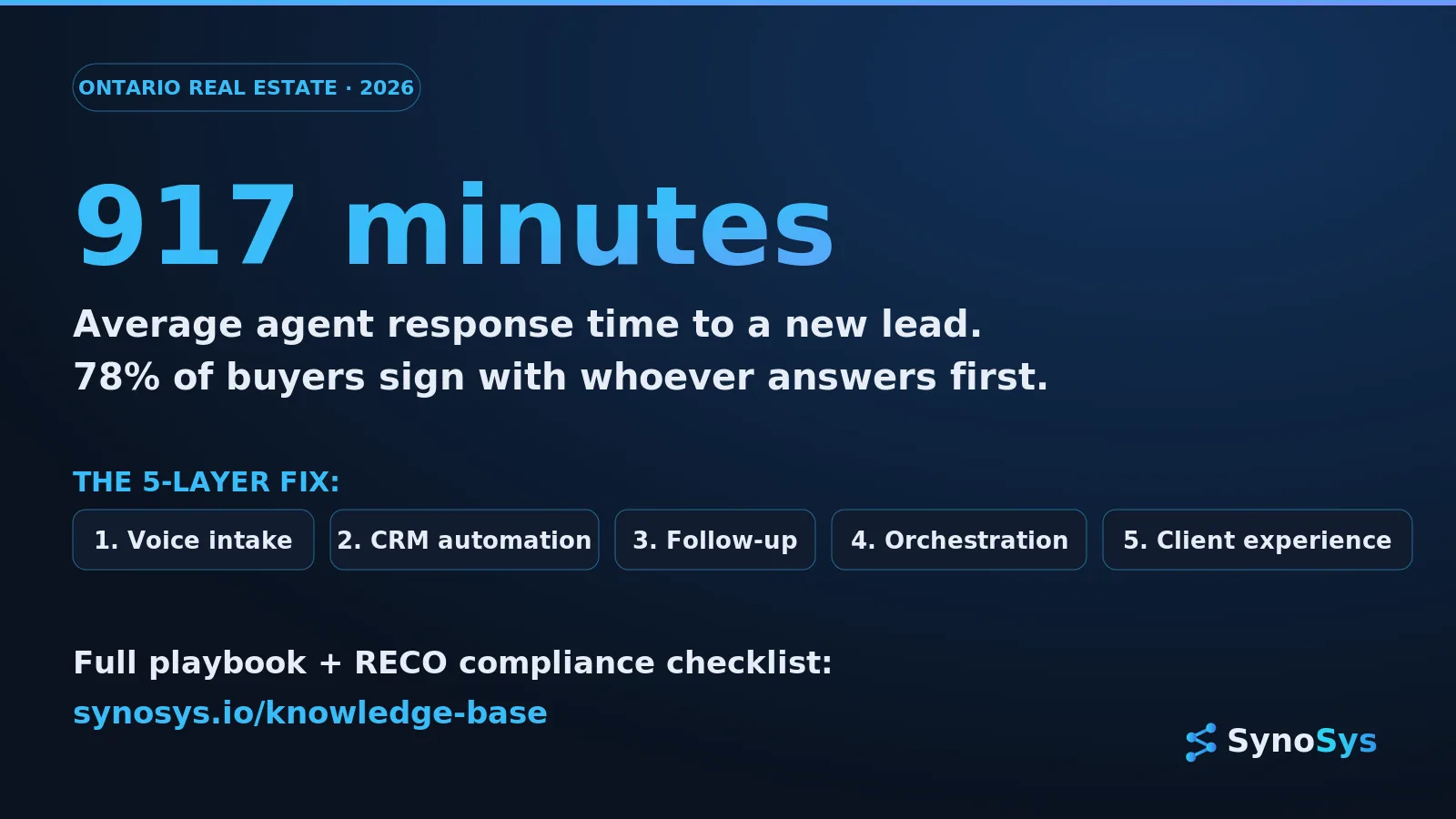
The five-layer Synosys AI operations stack for Ontario real estate teams, with the 917-minute average lead response statistic.
The five-layer Synosys AI operations stack for real estate.
The problem nobody measures
Real estate teams in Ontario do not have a lead problem. They have a capture problem.
The phone rings during a showing. A portal inquiry lands at 9:47 PM. A sign call goes to voicemail on Saturday and the buyer dials the next number on the street. By Monday, nobody is sure which leads got a callback and which ones quietly signed with a competitor.
The cost is invisible because it never shows up in one report. It shows up as flat GP despite steady ad spend. As a buyer's agent with empty Thursday slots. As a team lead paying for Zillow and Realtor.ca leads that convert at 2% when the industry's fast responders convert the same leads at 4 to 6%.
And the market is about to punish slow operations harder. TRREB called 2026 a year of two halves, and the second half just arrived. June sales were up 9.4% year over year while new listings fell 12.9%. More than 100,000 GTA buyers have been waiting on the sidelines. When they move, they will not call around. They will work with whoever answers first.
The speed-to-lead scoreboard
917 min
Average agent response time to a new lead. Over 15 hours.
21x
Higher conversion odds when you respond in 5 minutes instead of 30.
62%
Share of inquiries that arrive outside business hours.
78%
Buyers who work with the first agent who responds.
You are not losing deals to better agents. You are losing them to faster phones.
What an "operations stack" actually means
An operations stack is the path an inbound lead travels from first signal to closed transaction, and everything that keeps the relationship alive after. The path has layers, and each layer has a job. When a layer is missing, leads fall through it. When the stack is complete, the business compounds.
Every AI trend hitting real estate in 2026, voice agents, agent frameworks, CRM automation, workflow orchestration, fits into one of five layers. Build them in order.
The five-layer stack
AI Voice Intake
The 24/7 front door. An AI voice agent answers every call in seconds, day or night. It greets the caller in natural conversation, identifies intent, and captures what your workflow needs: budget, timeline, target area, pre-approval status, listing address for sign calls. It books showings directly into your calendar and sends you a transcript and summary of every conversation. Built on a real LLM, not a phone tree, so it handles interruptions and the messy way buyers actually talk. Quick win: one Ontario brokerage cut lead response from 4.2 hours to under 90 seconds and booked 33% more showings.
CRM Automation
Your CRM is only useful if it is current, and no agent became a top producer by doing data entry. Every call, text, and form fill is auto-logged as a contact with notes attached. Lead scoring surfaces who to call first each morning. Pipeline stages update themselves from conversation outcomes. Quick win: agents running AI-assisted CRM workflows report 15 to 25 hours recovered per week.
Sales Follow-Up Automation
Most deals are lost between touch 2 and touch 8. Automation does not get bored. Instant text-back on missed calls. Multi-touch sequences by lead type: buyer, seller, investor. Automatic bumps when a lead goes quiet. And a hard rule: the moment a lead replies with intent, a human takes over. Quick win: moving response time from 15 hours to under 1 minute can push conversion from 2% to 4 to 6%. Same ad spend, double the deals.
Workflow Orchestration
The brain that connects everything. One inquiry triggers the full chain: answer, qualify, book, log, follow up. Urgent leads, pre-approved and ready to view, route straight to your phone. Everything else flows without a human touching it. The routing rules are not buried in code. They are visible, editable, and owned by you. Quick win: brokerages running an AI-first qualification stack close roughly 3.4x more deals per lead than teams on manual follow-up.
Client Experience Automation
After the contract, the relationship. Automated transaction milestone updates so clients stop calling to ask "what happens next." Post-showing feedback collection. Review requests timed to closing day. Anniversary and market-update touches that keep you top of mind for the referral. Quick win: this layer costs almost nothing to run once the first four exist, and referral business compounds.
The RECO rule set is the moat
Most AI tools fail at the same place in real estate: compliance. RECO is now actively examining AI-generated content, and TRESA already applies to it.
Every AI output an agent publishes is still the agent's legal work product, and the brokerage's. An AI-enhanced listing photo that adds a window the property does not have is a misrepresentation. An AI-drafted CMA with a hallucinated sale price is a pricing misrepresentation with your name on it. And all advertising still requires your brokerage name and must be truthful.
The fix is structural: human sign-off on every client-facing AI output, and a one-page brokerage AI policy written before the first complaint, not after. A properly built stack is scoped, tested, and compliant by design. A pile of disconnected AI apps is not.
Where this fails
For the operators who like the bad news first. This stack is not a fit for every agent. It assumes real inbound volume worth automating, a defined farm or lead source, and a team lead willing to be honest about what actually happens to a lead after the phone rings.
It also fails when the qualification layer is skipped. A voice agent that answers everything but qualifies nothing just moves the bottleneck to your follow-up queue. If a provider is selling you the conversational layer without the routing logic, walk away.
Your 30-day rollout
Week 1: Audit.
Count your missed calls and after-hours inquiries. Most teams have never measured this number.
Week 2: Voice intake live.
AI answering on overflow and after-hours first. Lowest risk, highest ROI.
Week 3: Connect the CRM.
Auto-logging, lead scoring, and instant follow-up sequences.
Week 4: Orchestrate and measure.
Full routing rules live. Compare booked showings against your Week 1 baseline.
Why now
The voice layer of AI crossed the usability threshold in the last twelve months. Latency is down, interruption handling feels natural, and the cost per conversation is a fraction of a staffed call. The stack itself is the durable part. The models behind it keep improving, and teams that install the architecture now inherit those gains automatically. Teams that wait do not get to skip the lift. They just start it later, further behind.
Ontario's 2026 market will not reward whoever spends the most on leads. It rewards whoever loses the fewest.
Want to see the stack mapped to your team?
Run your numbers through the ROI Calculator at https://synosys.io/roi-calculator or
book the call