
Article: Too Custom vs Too Rigid: The 2026 Buyer's Guide to Clinic Intake Automation
Clinics shopping for intake automation get pushed toward two extremes: six-figure bespoke builds or rigid all-in-one platforms. Both fail for the same reason. Here is the total cost of each model, the middle path, and a 30-day evaluation plan.
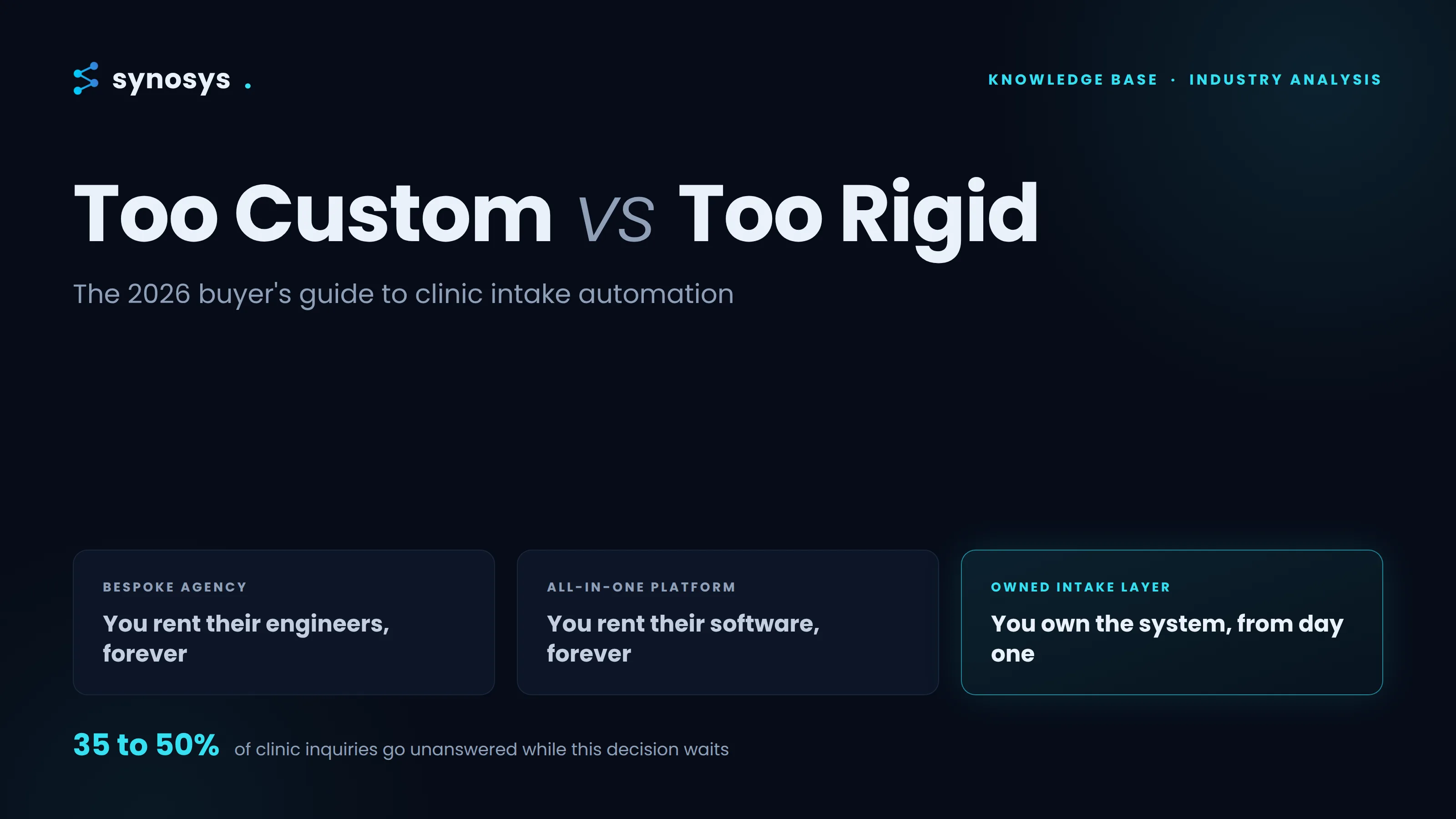
The decision nobody prepares you for
If you manage a multi-therapist clinic and you have started shopping for intake automation, you have probably noticed something strange. Every vendor you talk to sits at one of two extremes, and both of them talk past you.
On one side are the bespoke integrators. Custom-built voice systems, enterprise compliance credentials, references from hospital networks and public-sector booking lines. Impressive. Also six figures, six months, and a sales process that assumes you have a procurement department. On the other side are the all-in-one platforms. One subscription, one dashboard, phones and texting and payments bundled together. Affordable on paper. Easy to sign up for. And built on the assumption that your clinic should adapt to the software, not the other way around.
Neither of these was designed for a 5-to-25 practitioner clinic. But the pressure to pick one is real, because the cost of doing nothing keeps compounding.
The scoreboard: what inaction costs a clinic
35 to 50%
Share of inbound inquiries at clinics that go unanswered during peak periods, based on industry benchmarks. Each one is a patient who may simply call the next clinic.
$60,000+
Approximate annual cost of front-desk administration at a typical clinic in salary and overhead, anchored to Ontario's $25.00/hr median wage for medical administrative assistants.
7x
How much more likely a lead is to qualify when contacted within an hour instead of later, per Harvard Business Review research. Wait a day and the multiplier collapses to 60x worse.
20 to 30%
No-show rates reported in some Canadian care settings. Every unfilled slot is unrecoverable clinical capacity.
Those numbers are why automation is on your desk in the first place. The question is not whether to fix the intake gap. It is which of three very different models you fix it with, and what each one actually costs you over three years, not three months.
Model 1. The bespoke trap: paying enterprise prices for a dependency
Custom integration agencies do genuinely good engineering. Their systems handle heavy accents, interruptions, and complex routing. They plug into health record systems securely. Their client lists include hospital booking lines and regulated enterprises for a reason. If you are a hospital network with a seven-figure IT budget and a procurement team, they are often the right call.
The problem is what the model costs a smaller clinic, and the cost has three parts.
The price filters you out
Bespoke builds are priced as capital projects. The upfront investment alone puts them out of reach for most private clinics, before you count the ongoing engagement. These agencies are not being greedy. Custom engineering genuinely costs that much. It is simply a product built for a different buyer.
The timeline works against you
Custom code means custom timelines, measured in months. While a system is being scoped, built, and tested, your phone lines are still overflowing at 8am, your lunch-hour queue is still backing up, and your after-hours calls are still hitting voicemail. At a 35 to 50% missed-inquiry rate, a six-month build has a six-month leak running alongside it.
The dependency never ends
This is the part that rarely comes up in the sales call. When your booking rules change, your hours shift, or you add a practitioner, you cannot touch the system yourself. Every update is a ticket, a quote, and billable agency hours. The business logic of your own front door lives in code only they can modify.
Model 2. The platform trap: renting a system that will never quite fit
The all-in-one platforms solve the price problem. Entry plans in this category list around US$250 per month per location, plus onboarding fees in the several-hundred-dollar range and contract commitments. Accessible, standardized, easy to sign. And in solving the price problem, they create three new ones.
Rigidity by design
A standardized platform is standardized for everyone. Your intake questions, your triage logic, the way your physiotherapy side books differently from your mental-health side: if the platform does not have a setting for it, it does not happen. There is no engineer to call, because there is no engineering. You get the workflow the product team shipped, and so does every other clinic on the platform. Specialized AI reasoning and custom workflows are precisely what the standardized model cannot offer.
The bundle you did not ask for
Most platforms make you adopt their whole ecosystem to get the one thing you wanted. New VoIP desk phones, new messaging, sometimes new payment processing with per-transaction fees. You came for intake automation and left with a full communications migration, plus staff retraining and the downtime risk that comes with it.
Lock-in by design
A subscription platform's revenue depends on you never leaving, so the system is structured to make leaving painful. Your workflows live in their infrastructure. Your data lives in their format. The day you cancel, everything stops working, and the hardware on your desks becomes decoration. The pricing looks friendly. The exit does not.
Layer on the complaints that consistently show up in user reviews of the big platforms, slow support queues, buggy mobile apps, database syncing issues, and the "affordable" option starts carrying real hidden costs. When your intake fails at a clinic, it is not an IT inconvenience. It is a patient-facing event, and you are in a support queue behind thousands of other locations.
Why both extremes fail for the same reason
Strip away the details and the two models share one flaw: in both cases, someone other than you controls your intake system. The bespoke agency controls it through code only they can change. The platform controls it through infrastructure only they operate. Different mechanisms, identical result. Your clinic's front door, the mechanism that turns inquiries into booked appointments, belongs to a vendor.
In most industries that is a strategic annoyance. In Ontario healthcare it is a compliance exposure. Your intake process touches personal health information governed by PHIPA, and the regulatory temperature is rising: Ontario's Information and Privacy Commissioner has shown willingness to levy penalties in the hundreds of thousands of dollars for mishandled health information, and emerging provincial guidance on clinical AI requires human validation before data enters patient records. The direction of travel is clear. Transparency, auditability, and demonstrable control over your systems are becoming table stakes.
Model 3. What the middle path looks like
There is a third model, and it is defined by four properties. Use them as an evaluation checklist for any vendor, including us.
It layers on top of what you already use.
The right system connects to your existing booking software, calendar, EHR, and phone number. It does not replace them. Clinics are rightly reluctant to swap systems their staff already know; conversions mean downtime, retraining, and risk. If a vendor's first step is ripping out your current tools, the disruption cost alone will eat the first year of benefits. Quick win: an upstream layer can go live on after-hours and overflow calls first, where the leak is worst and the risk is lowest.
It is customized where it counts, standardized where it does not
You do not need six months of ground-up engineering. You need your actual booking rules, intake questions, practitioner availability, and triage logic configured into a proven architecture. Custom logic on reusable foundations. That is how deployment happens in weeks instead of quarters, and how the price lands at a monthly retainer a clinic can justify instead of a capital project only a hospital can.
You own it
Every account, every integration, every line of automation logic in your clinic's name from day one. Not licensed. Not hosted on someone else's terms. Owned. This single property dissolves both traps at once: no agency dependency, because the system is yours to modify or hand to any developer; no platform lock-in, because a vendor who walks away leaves you with a working system, not a dead subscription. It is also the property that makes the compliance chain work, because you can audit what you own.
Support is optional, not hostage-taking
Ongoing optimization is genuinely valuable. Most clinics want a partner monitoring performance and tuning the system against real call volumes, and a defined post-launch optimization period should be part of any serious engagement. But that support must be something you choose to keep paying for because it earns its fee, not something you are forced to keep paying for because cancelling kills your intake.
The three-year math
Run the models side by side against the labour benchmark every clinic already understands. One full-time medical administrative assistant in Ontario costs roughly $48,800 per year at the median wage before payroll taxes, benefits, and coverage gaps, and the fully loaded administrative workload at a typical clinic runs past $60,000. The bespoke model asks for a six-figure outlay before the system answers its first call, then bills for every change after. The platform model looks cheap per month, but price it honestly: subscription plus onboarding plus transaction fees plus the migration and retraining costs of adopting the bundle, multiplied across locations, forever, with nothing owned at the end. The middle path prices as a monthly retainer in the low four figures. At roughly $18,000 per year, an owned intake layer runs at less than a third of the labour cost it offsets, covers hours no employee can work, and at the end of the engagement the asset is yours.
That last clause is the part the other two models cannot say, and it changes what the spend is. With a subscription, three years of payments buys three years of access. With an owned build, the same period buys infrastructure your clinic keeps.
Where the middle path fails
For the operators who like the bad news first: this model is not a fit for everyone, and pretending otherwise is how vendors lose trust.
It fails when there is not enough inbound volume to automate. A solo practitioner fielding fifteen calls a week does not need an intake layer; the math only works when missed inquiries are a real, recurring leak, which is why the natural fit starts around multi-practitioner clinics handling hundreds of interactions weekly. It fails when a clinic genuinely needs hospital-grade custom engineering, deep integration into enterprise health record infrastructure at institutional scale. If that is your requirement, hire the bespoke integrator and pay what it costs. And it fails when ownership is handed over without operational readiness: a clinic that owns a system nobody on staff understands has traded vendor dependency for key-person risk. Insist on documentation, staff training, and a defined optimization period as deliverables, not extras.
Your 30-day evaluation plan
Measure the leak
Count missed calls, after-hours inquiries, and abandoned web forms for five business days. Most clinics have never measured this number, and it is the baseline every vendor claim gets tested against.
Shortlist by model, not by demo
Sort every vendor into one of the three models before you watch a single demo. The model determines the three-year cost and the exit terms; the demo only determines how good the sales engineering is.
Ask the five questions
Does this work with my current booking system, or replace it? Who owns the accounts, integrations, and automation logic after launch? What happens to the system if I stop paying? How long from signed agreement to live system? When my booking rules change, who makes the update, and what does it cost?
Test live before you commit
Any serious vendor can put a working system against your real call flow before you sign a long-term commitment. If the only way to evaluate the product is to buy it, that tells you which model you are looking at.
The answers will tell you exactly which of the three models is in front of you. Two of them put your front door in someone else's hands. One of them does not.
Why now
The environment is moving fast in one direction. The share of Canadian businesses using AI has tripled in two years to 19.2%, with adoption highest in professional services at 32.4%, and virtual agents are now among the most common deployments. Ontario is investing $3.4 billion in primary care while separately mandating the reduction of administrative burden on clinics. Patients have been trained by every other industry to expect an answer in seconds, at any hour. Clinics that install an owned intake layer now inherit every model improvement automatically, because the architecture is theirs. Clinics that wait do not get to skip the decision. They just make it later, with a bigger leak behind them.
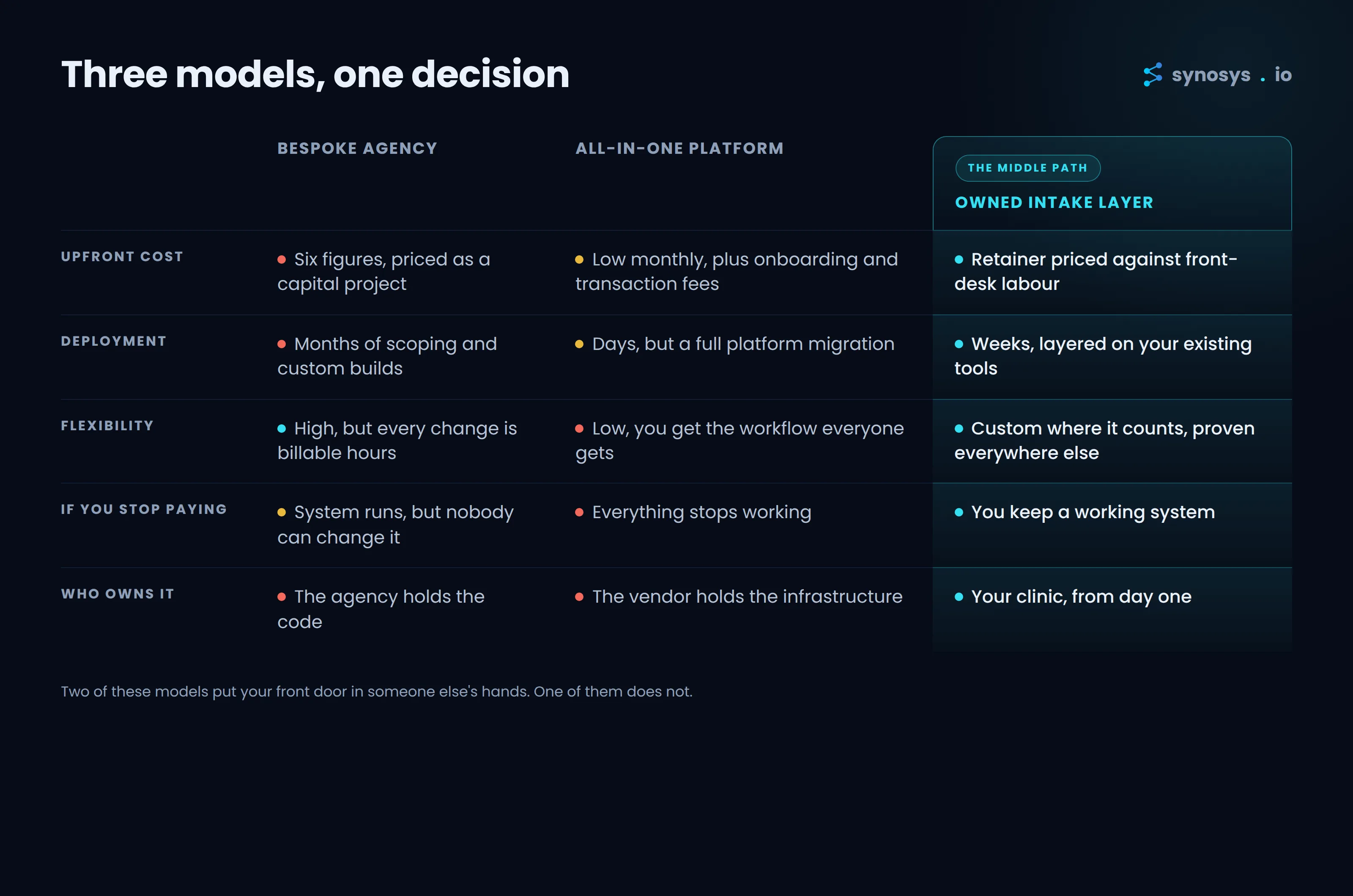
See which model your current vendors are actually selling you.
The free intake audit measures your real missed-call leak and puts a live, owned system against your actual call flow before you commit to anything. No migration, no new platform, no lock-in. Which is exactly how it should be
Book Free Audit