
Follow the Voice: Where Your Patient's Call Actually Goes When an AI Answers It
A patient calls your clinic at 9pm and an AI picks up. Their voice can leave Canada three times before the call ends. Here is the full route, what Canadian privacy law actually asks of you, and the nine questions that get a straight answer out of any vendor.
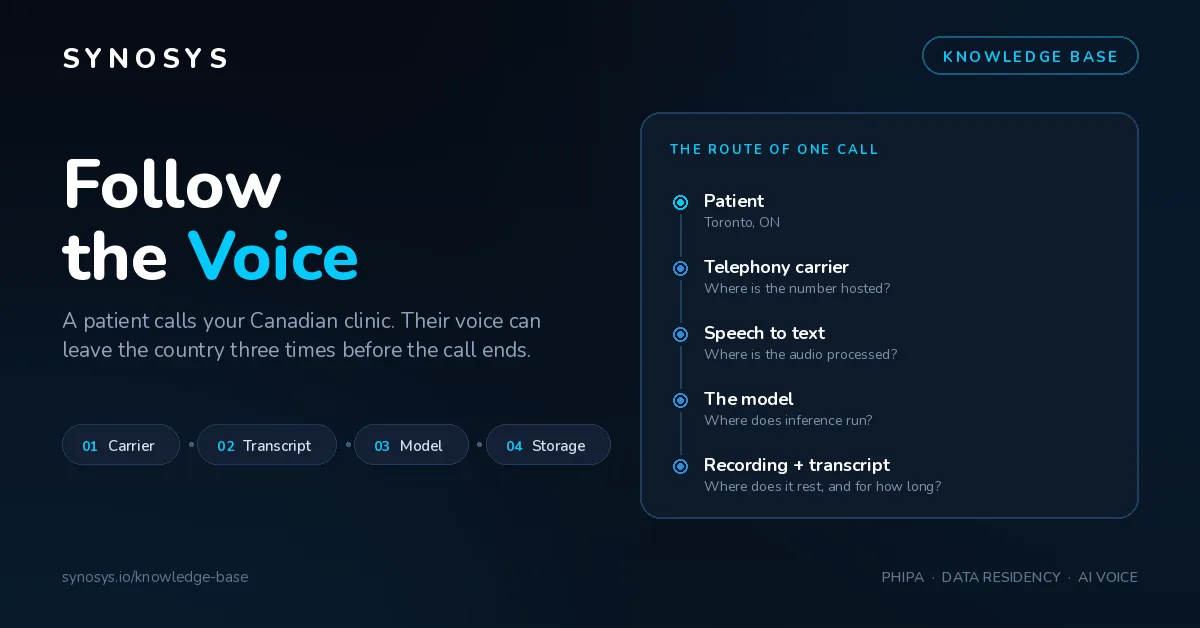
One patient call. Five hops. One accountable custodian.
It's 9:12 pm and the phone gets answered
A patient calls your clinic. It's past closing. The line picks up on the second ring, a calm voice says it's an AI assistant, checks the schedule, and books them for Thursday at 10:40 am. The patient hangs up happy. Your front desk finds a clean summary in the morning.
Everything about that call felt local. The number is a Canadian number. The clinic is on a Canadian street. The patient is sitting in their kitchen in Ontario.
Their voice may have left the country three times before they hung up.
That is not a scandal, and it is not a reason to avoid AI on the phone. It is just a fact about how these systems are assembled, and most clinic owners have never been shown the map. So here is the map.
Why this stopped being a technical footnote in 2026
For a couple of years, AI on the clinic phone was treated as a phone problem. It is now treated as a privacy problem, because the regulators started writing about it.
Ontario's Information and Privacy Commissioner issued guidance in January 2026 recommending that clinics deploying AI stand up a governance committee, or equivalent oversight, with real authority to approve, pause, or decommission an AI deployment. British Columbia's Office of the Information and Privacy Commissioner published its own guidance on January 28, 2026. The statutes differ. The principles converge on the same three things: informed consent, human oversight, and safeguards you can actually evidence.
There is one more point that matters more than all of the above, and it is the one clinic owners consistently miss. Under PHIPA, when a vendor operates an AI system that touches personal health information, the health information custodian remains accountable for that information. You do not outsource the obligation when you outsource the software. The vendor is your agent. The name on the regulator's letter is yours.
The route, hop by hop
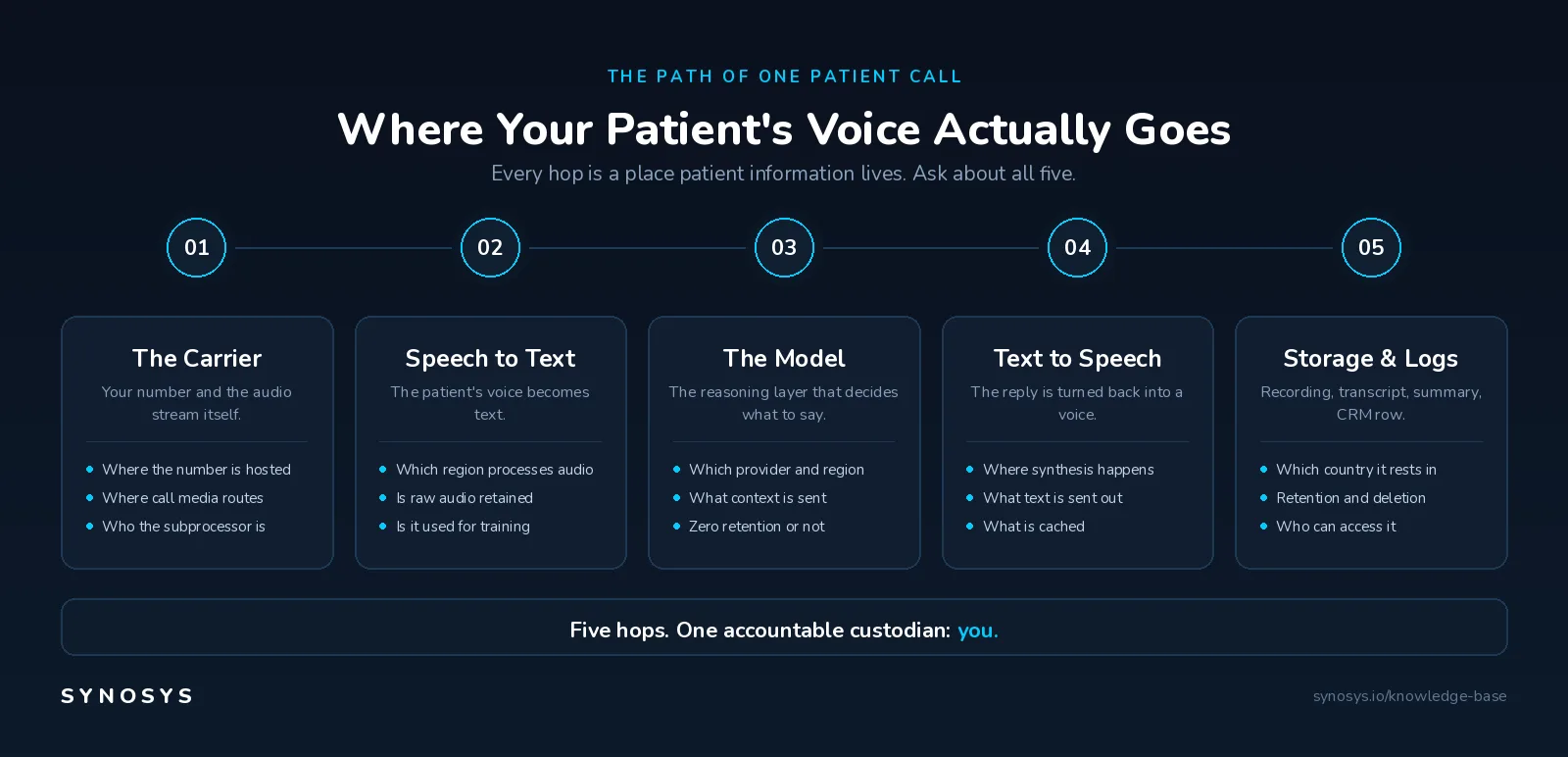
Here is what actually happens between the patient speaking and your calendar updating. Five hops. Each one is a separate company, a separate contract, and a separate place where patient information exists.
The carrier
Your phone number and the audio itself. The number is registered somewhere, and the call media routes through somewhere, and those are not always the same country. This is also the hop most likely to be a subprocessor of a subprocessor, which is why it rarely appears on a vendor's compliance page.
Speech to text
The patient's voice becomes words. This is the first place raw audio of a patient describing why they are calling exists as a file on a server. The questions that matter here are which region processes it, whether the raw audio is retained after transcription, and whether it can be used to improve the provider's models.
The model
The reasoning layer that decides what to say next. It receives whatever context the system sends it, which may include the caller's name, their reason for calling, and their appointment history. Where inference runs, and whether the provider has a zero-retention arrangement, are two separate questions with two separate answers.
Text to speech
The reply is turned back into audio. Lower risk than the others, because it usually only sees the outbound text, but it is still a hop, still a vendor, and still worth naming on your data flow diagram.
Storage and logs
The call recording, the transcript, the summary, the row that lands in your CRM or spreadsheet, the SMS confirmation. This is the hop that outlives the call by months or years, and it is the one clinics ask about last. Which country does it rest in, how long is it kept, who inside the vendor can open it, and how is it deleted.
The mistake almost every clinic makes on the first call with a vendor
They see a compliance badge and stop reading.
Here is the tell. Watch how carefully a vendor separates its jurisdictions. One well-known healthcare voice provider states plainly that it offers HIPAA compliance with US-based data centres for American healthcare, and PIPEDA compliance with Canadian data residency for Canada. That is the honest version, and it is also the warning label: the compliance you get depends on which arrangement you are actually signed up to. A HIPAA badge tells you about a US framework. It says nothing about your obligations under PHIPA in Ontario, PIPA in British Columbia or Alberta, or Law 25 in Quebec.
The gaps in practice are rarely dramatic. They are quiet. Audio that routes through a US server for processing on a system that otherwise stores data in Canada. A consent workflow set up once at launch and never revisited. A vendor agreement with no retention or deletion language in it at all. Nobody set out to cut a corner. Nobody drew the map either.
And it is not a fringe risk. In the adjacent world of AI medical scribes, a 2026 comparison of vendors serving Ontario family doctors found that two of the three leading stacks still defaulted to US storage.
The nine questions
Ask these before you sign anything. A vendor who has done the work will answer all nine in one meeting. A vendor who has not will offer to send you their compliance page.
Show me the data flow diagram
Every hop, every subprocessor, named. If they cannot draw it, they do not know it.
In which country is each hop processed, and where does the data rest?
Processing location and storage location are two different answers.
Is call audio retained after transcription, and can any provider in the chain use our data to train models?
Get this in writing. Under PHIPA, information used for care is treated differently from information used for training or QA, and the second usually needs express consent or proper de-identification.
Will you sign an agreement naming you as our agent, with retention and deletion obligations spelled out?
This is the document that makes the arrangement work. A terms-of-service page is not it.
What exactly does the agent disclose to the caller, and when?
Patients should be told AI is in use, told what is collected, and given a path to a human. A disclosure buried at the end of a call is not a disclosure.
What happens when a patient says they do not want to speak to an AI?
There should be a real answer, not a shrug.
Can we see the audit log?
Who accessed which recording, when. If the answer is that support staff can open any call, that is your answer.
What is the minimum information the agent needs to do its job?
Then push to cut it further. The safest patient data is the data you never collected.
When we leave, what happens to the number, the recordings, and the transcripts?
Ask on day one, not on the day you leave.
How we handle it
We are a small Canadian team, and we are not going to pretend we have an enterprise trust centre. What we do have is a way of working that we can show you.
We map the path before we build. Every engagement starts with the diagram above, filled in with the real vendors we would use for your clinic. You get it in writing, and you get it before you commit to anything.
We collect the least we can get away with. On a recent build for a Canadian multi-practitioner clinic group, the after-hours agent held no health information beyond a first name and whether the caller was already registered. It never took a card number. It never gave clinical advice. It answered from a defined knowledge base and nothing else, and when a question fell outside that scope it said so and took a message.
Every call discloses the AI, upfront. Not as a legal shield. Because patients respond well to honesty and badly to being tricked, and trust is the whole product in healthcare.
A human is always reachable. The agent is a layer in front of your team, not a replacement for it. Anything urgent, sensitive, or off-script goes to a person with the context attached.
You own the system. We provision the infrastructure in your clinic's name and hand it over. The number, the recordings, the logs, the accounts. If you stop working with us, the system keeps running and the data stays yours. We think that should be the norm and we are aware that it is not.
We write to your province, not to a generic template. An Ontario clinic and a British Columbia clinic do not have the same obligations, and the paperwork should not pretend otherwise.
Back to 9:12 pm
The call still gets answered. The appointment still gets booked. The patient still hangs up happy, and your front desk still finds a clean summary in the morning.
The difference is that you can now say, out loud and specifically, where that patient's voice went and how long it stays there. If a patient asks, you have an answer. If your regulator asks, you have a diagram.
That is not a compliance exercise. That is just knowing what you bought.
Not sure where your calls go today?
Finding out is part of our free intake audit, and we will map it whether or not you work with us.
Book an AuditSources
Ontario IPC guidance on AI and PHIPA, including governance, data residency, and vendor agreement requirements: https://opsmed.ca/ai-scribes/ and https://opsmed.ca/blog/ai-scribe-compliance-ontarios-new-rules/
British Columbia OIPC guidance for private-sector healthcare organizations under PIPA, January 28, 2026: https://opsmed.ca/blog/ai-scribe-compliance-ontarios-new-rules/
Custodian accountability for vendor-operated AI, and the distinction between PHI used for care and PHI used for training or QA: https://aihealthcarecompliance.com/resources/applicable-laws/phipa/
Patient notification, consent, and non-AI alternatives: https://fusioncomputing.ca/ai-for-healthcare-clinics-canada/
US default storage among leading AI scribe vendors serving Ontario: https://fusioncomputing.ca/ai-scribes-ontario-family-doctors-phipa-comparison/
Vendor jurisdiction split, HIPAA with US data centres versus PIPEDA with Canadian residency: https://www.kickcall.ai/healthcare
Provincial health privacy statutes, PHIPA, PIPA, HIA, and Law 25: https://scribeberry.com/blog/pipeda-compliant-ai-scribe-what-canadian-physicians-need-to-know-in-2026
Third-party platforms handling PHI as service providers, and data minimization in patient reminders: https://opsmed.ca/resources/phipa-compliance-guide/