
From Audit to Launch: How a Synosys Voice Agent Actually Gets Built
The audit comes first, the numbers come second, and the voice agent comes last. Here is the full journey.
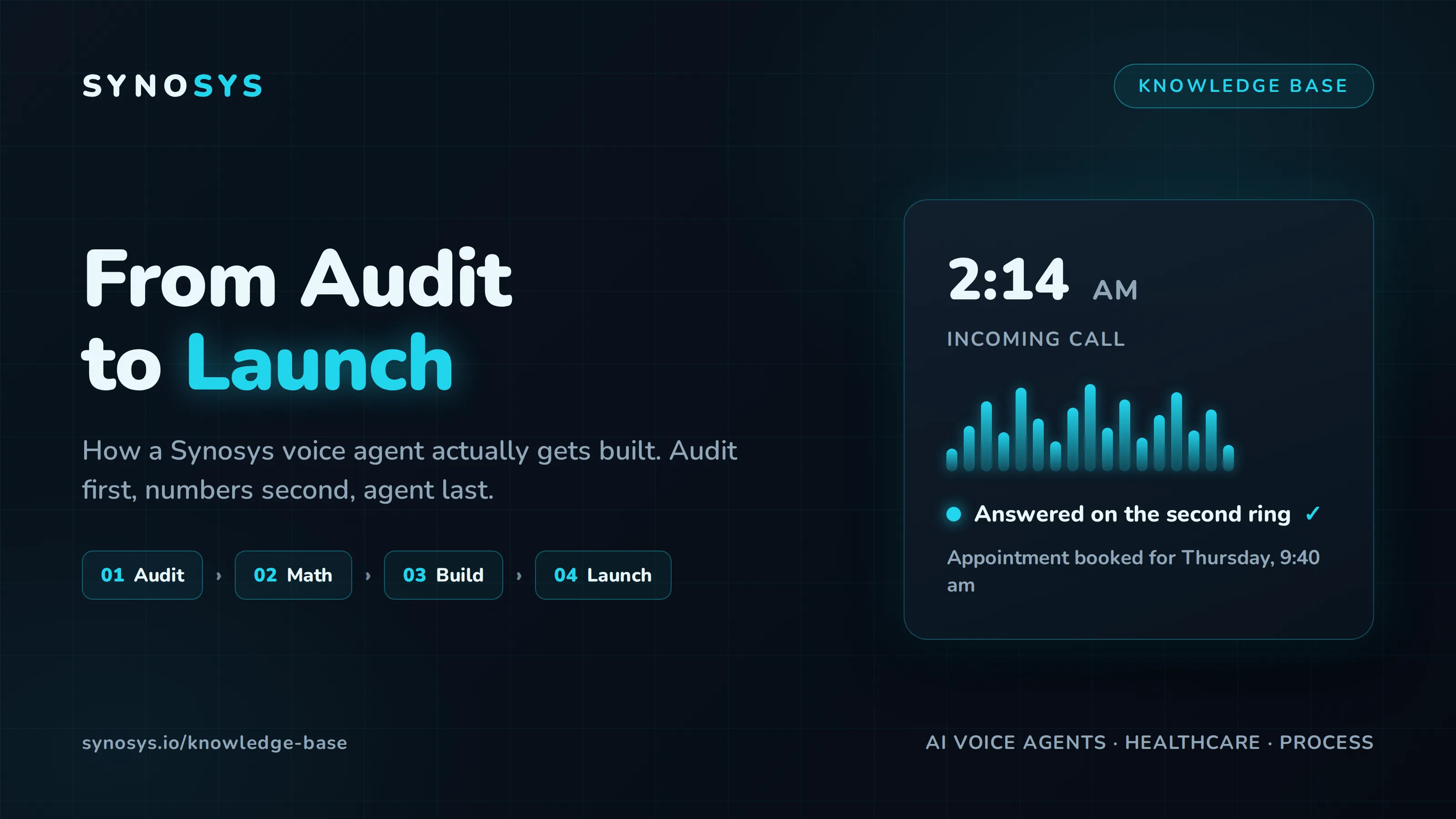
Let's start at the end.
It's 2:14 am. A patient calls your clinic. The phone picks up on the second ring. A calm voice answers, tells them upfront it's an AI assistant, checks the schedule, and books them in for Thursday morning. The patient hangs up with an appointment. Your staff finds a clean summary waiting for them at 8 am.
That's the finish line. Now let's rewind and show you how we get there, because the voice agent is actually the last step, not the first.
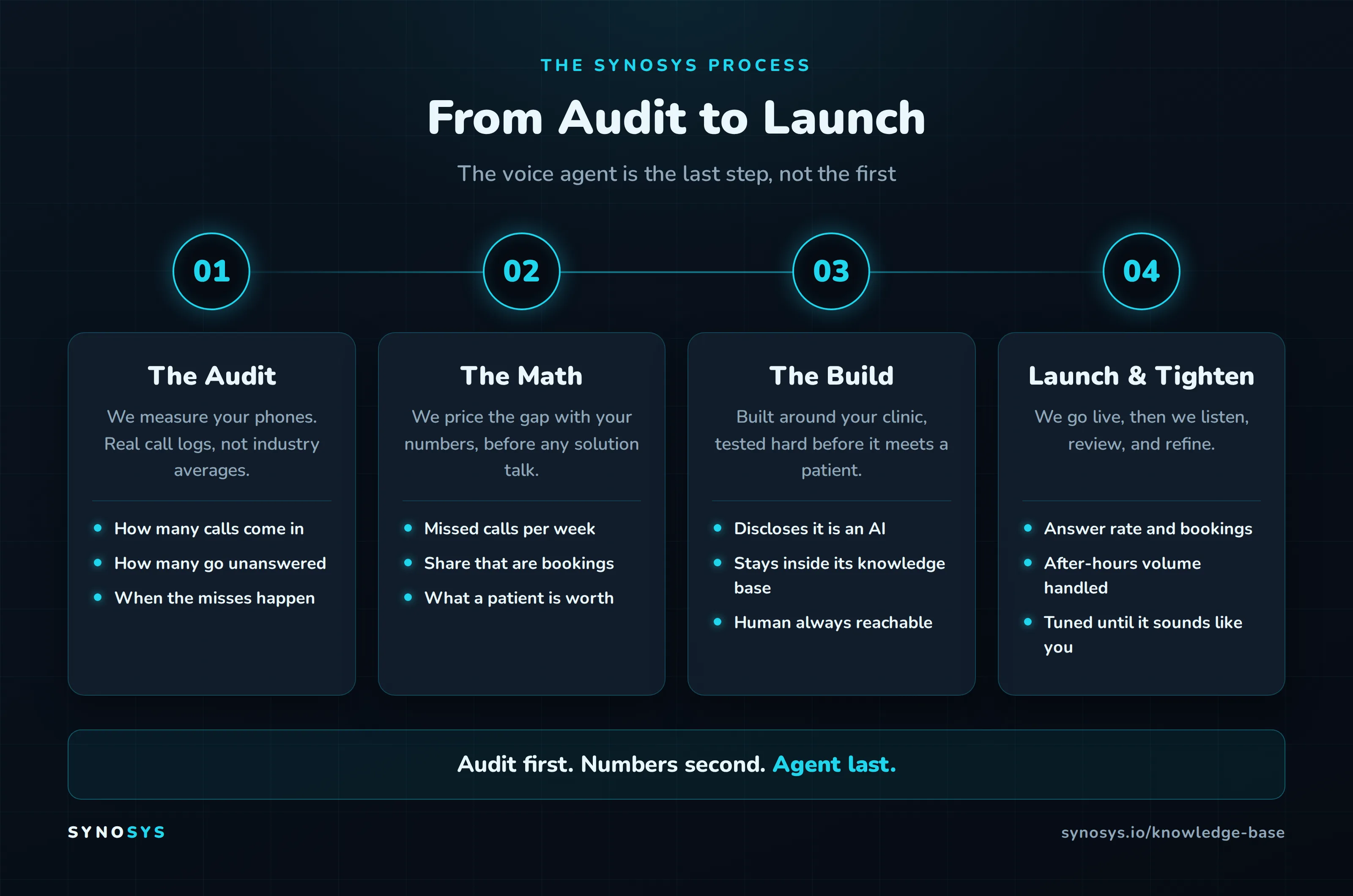
The audit
We measure your real call volume, miss rate, and when the misses happen.
The math
We price what those missed calls cost your clinic, with your numbers.
The build
We create the agent around your clinic, then test it hard before launch.
Launch and tighten
We go live, review real calls, and refine until it sounds like you.
Why the phone still decides who gets the patient
Before we talk process, it's worth being clear about why any of this matters.
Despite portals, apps, and online booking, the phone is still the front door of healthcare. Industry research puts it plainly: about 67 percent of patients prefer to call their provider rather than use a digital channel, and roughly 80 percent of appointments are still scheduled over the phone. When someone needs care, they don't fill out a form and wait. They call.
And when that call goes unanswered, the patient doesn't politely wait either. CallRail's 2025 survey of 1,000 consumers found that fewer than half of callers leave a voicemail when nobody picks up. The widely cited figure from PATLive is that 85 percent of callers who don't get through never call back. They call the next clinic on the list. Research compiled by Dialog Health found that patients with a poor phone experience are four times more likely to switch providers entirely.
So a missed call is rarely just a missed conversation. It's often the whole patient relationship, gone before it started, and it usually goes to whoever answers next.
Step 1: The audit
We never start by selling you software. We start by measuring the problem.
The audit answers three questions. How many calls actually come into your clinic? How many go unanswered? And when do the misses happen? For most clinics the pattern is predictable: the morning rush when check-ins and calls collide, lunch hours, peak overflow when three lines ring at once, and everything after 5 pm.
That after-hours window is bigger than most owners think. Studies of patient call behaviour consistently find that a large share of patient calls, with some analyses putting it around 40 percent, come in outside standard business hours. These aren't all emergencies. Many are people trying to book, reschedule, or ask a simple question about hours or preparation for a visit. If your clinic closes at 5 pm and reopens at 8 am, that's 15 hours of patient demand every weekday landing on a voicemail box that most callers will never use.
We pull all of this from your call logs and your published hours. No guesswork, no industry averages standing in for your reality. Just your real numbers, laid out clearly. Sometimes the audit shows a small gap. Sometimes it shows a canyon. Either way, you'll know.
Step 2: The math
Missed calls feel like a small annoyance until you price them.
The formula is simple. Take your missed calls per week. Multiply by the share that are new patients or bookings. Multiply that by what a patient is worth to your clinic, not just the first visit, but the relationship. Depending on the specialty, analyses of patient lifetime value put that anywhere from a few thousand dollars to well beyond it once you count years of visits and referrals.
There's a second layer to the math that has nothing to do with new patients. Speed matters even for the calls you eventually return. Research on lead response consistently shows that the majority of customers go with the business that responds first. In healthcare terms: the patient who calls three clinics books with the one that picks up.
We put this number in front of you before we talk about any solution. And if the math doesn't justify the fix, we tell you that too. Some clinics genuinely don't miss enough calls to need us. Most, once they see their own logs, are surprised in the other direction.
Step 3: The build
This is where the voice agent gets made, and it's where most of the careful work lives.
We build the agent around your clinic, not the other way around. That starts with a discovery session where we map out your services, your hours, your booking rules, your locations, and your escalation points. Who should be reached if a call sounds urgent? What questions should the agent answer, and which should it never touch? What does your clinic sound like when it's at its best? All of that goes into a defined knowledge base that the agent works from.
Then we test it hard, before it ever talks to a real patient. On a recent build for a Canadian multi-practitioner clinic group, we went through twelve prompt revisions before launch. We call the agent ourselves, try to confuse it, push it off script, and tighten it every time it wobbles.
Non-negotiables
It says it's an AI
Every call, upfront. Patients respond well to honesty and poorly to tricks. Disclosure builds trust, and trust is the whole game in healthcare.
It stays inside its knowledge base
If a question is out of scope, it doesn't improvise and it never gives medical advice. It takes a message or routes the call.
A human is always reachable
The moment a call needs a person, the agent hands it off or sets up a callback. The agent is a layer in front of your team, not a replacement for it.
Step 4: Launch and tighten
We go live, then we listen.
The first weeks are about reviewing real calls, tightening responses, and adjusting anything that doesn't sound like your clinic. We track the numbers that matter: answer rate, bookings captured, after-hours volume handled, and how often calls escalate to a human. The agent gets better because we watch it work, not because we assume it's finished on day one.
This is also where the workforce side of the story shows up, and honestly, it may matter more than the revenue side.
Front desk work in healthcare is in rough shape. Surveys of medical practices found 58 percent naming staffing shortages as their top challenge, and industry data shows annual turnover for front office support staff running around 40 percent. In Canada specifically, the health sector was carrying more than 96,000 unfilled positions as of late 2022, and replacing a single frontline support hire has been estimated at $25,000 or more once you count recruiting, training, and lost productivity.
Your front desk team didn't burn out because they're bad at their jobs. They burned out because they were asked to check in the patient standing in front of them while three phone lines ring behind them. The agent absorbs the volume that was grinding them down: after-hours calls, overflow spikes, and the same twenty questions a day about hours, parking, and directions. Your people keep doing what only humans can do, which is care for the patient in the room.
Back to 2:14 am
Which brings us back to where we started. That late-night call gets answered because of everything that came before it: the audit that found the gap, the math that sized it, and the build that closed it, carefully, with disclosure on every call and a human always within reach.
That's the whole process. Audit first, numbers second, agent last.
What are your missed calls costing you?
Finding out is step one of our process, and it's free.
Book an auditSources
411 Locals study on small business call answer rates, via OnCrew's verified statistics register: https://oncrew.ai/resources/missed-call-statistics
CallRail 2025 consumer survey on voicemail behaviour, via OnCrew: https://oncrew.ai/resources/missed-call-statistics
PATLive research on callback behaviour, via Aira: https://www.getaira.io/blog/missed-business-calls-statistics
Patient phone preference and switching behaviour: https://www.dialoghealth.com/post/healthcare-call-center-statistics and https://telecloud.net/blog/urgent-care-call-visibility-what-is-happening-on-your-phones
After-hours patient call volume and phone scheduling share: https://answernet.com/costs-of-missed-calls-in-medical-offices-and-how-to-avoid-them/ and https://www.bland.ai/blog/best-medical-answering-services
Practice staffing and turnover data: https://calvient.com/resources/blog/burnout-practice-staff
Canadian health workforce vacancies and administrative staffing costs: https://www.canada.ca/en/health-canada/services/health-care-system/health-human-resources.html and https://www.medfarsolutions.com/en/clinic-administration-crisis