
Two Roofers, Same Fear About AI. One Is Still Losing Jobs.
Your homeowners really do prefer a human on the phone. Here is why that is not a reason to let your calls ring out, and how to check what it is costing you.
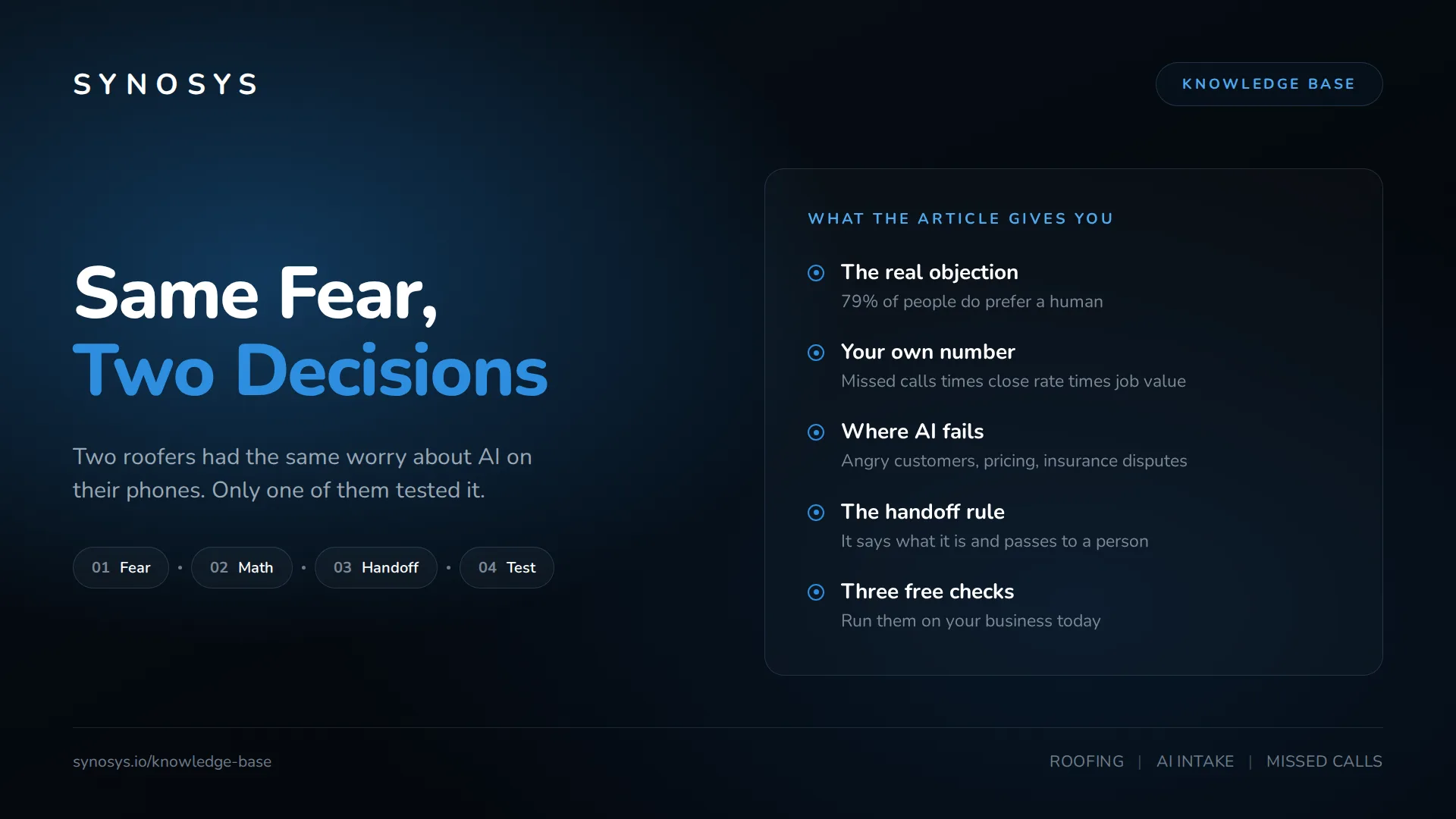
We heard the same sentence from two roofing owners last month. Same fear, word for word. Only one of them is still losing 8,000 dollar jobs to the company down the street.
If your gut says "I don't want a robot talking to my homeowners," your gut is reading the room correctly.
People do dislike talking to AI on the phone. In a December 2025 SurveyMonkey survey of 2,017 US adults, 79% said they strongly prefer dealing with a human, and 89% said companies must always offer a way to reach a real person.
So let us settle that part right now. Your customer would rather talk to you than to a machine.
The trouble is that the fact does not solve your actual problem. The question is not whether homeowners prefer a human. It is what happens when no human is free to pick up. Right now, for most roofing crews, that call hits voicemail.
Voicemail is not a human either. It is just a worse, older machine.
Two roads, same fear
Owner A let the fear decide.
He kept things standard. Calls hit his cell. If he is up on a tear off, it rings out. He calls people back around 7:00 PM when he finishes paperwork. He is not lazy. He is doing what almost every contractor does.
Owner B had the same fear, but tested the gap.
He did not fire anyone. He did not put AI in front of existing clients. He gave it one job: handle the calls already dying in voicemail.
When a new lead calls, a system answers on the first ring, captures their info, books the inspection, and texts him the details while he is still on the ladder. If the caller asks for a person, it routes straight to his cell.
Not "AI runs my company." Just zero missed opportunities.
Run the math on your own truck
Do not take a vendor's word for this. Run your own call log through the formula:
Missed calls per week, times your close rate, times your average job value, times 52.
Put in example numbers:
- Missed calls: 3 per week, so 156 a year
- Close rate: 25%, so one in four
- Average job: 8,000 dollars
That comes out to 39 lost jobs a year, a 312,000 dollar hole in your top line. Cut every one of those numbers in half and it is still the most expensive line item in your business. It just never shows up on your P&L, because you never knew those homeowners called.
Change the inputs to your real ones before you react to the size of it.
Where AI answering fails badly
Most software companies will not tell you this, but an automated system is worse than you at critical parts of your job:
- It cannot handle an angry client with a leaking job in progress.
- It should never quote prices on a roof it has not seen.
- It cannot read an anxious homeowner who is stressed about an insurance adjuster.
- It fails when it lies. In the same survey, 54% of people said they are confident they can tell when they are dealing with an AI. If your system pretends to be a receptionist named "Sarah," some callers will work it out and feel tricked. That breaks trust faster than a missed call ever will.
The only six things it should do on a roofing call
The job, start to finish
Instant answer
Pick up on ring one, at any hour, including a storm week when every call lands at once and your office line is already busy.
Basic intake
Collect name, service address, phone number and the issue. A leak, hail from Sunday, a full replacement quote.
Triage
Ask the two sorting questions. Is it an active emergency, and is there an insurance claim attached.
Calendar booking
Drop the inspection into a slot you set, not one it invented.
Text you the details
Before you are off the ladder.
Zero maze handoff
Transfer to a real person the moment they ask. No endless menus.
It is not trying to sound clever and it is not trying to be you. It makes sure a homeowner with water dripping onto their ceiling talks to somebody instead of a dial tone.
Three five minute audits you can do today
- Pull your last 7 days of call logs. Count every lead you did not call back within 60 minutes.
- Call your own business at 7:15 PM. Listen to your own prompt the way an upset homeowner would, one who is ready to hand over a deposit.
- Ask your last 5 clients one question. "How many roofers did you call before you got a live person?" The answer is rarely one.
If your log is clean and every lead gets a call back inside an hour, you do not need this. Some companies are already there. But if calls are slipping through, the fear of using the tech is costing you more than the tech ever would.
Where the fear was right, and where it was wrong
Owner A was right that his customers want a person. He was wrong that keeping it manual is how you give them one.
Owner B was right about the same thing, and he did something about the gap instead. His customers still get him. They just get him after they have already been answered, booked and written down, instead of hoping he calls back before the next company does.
The fear was never the mistake. Letting it decide everything, without testing it on one small piece of the business, was.
Want a direct look at your numbers?
We run a straightforward intake audit. We call your business off hours, test your response setup, and send you the raw findings. No sales pitch attached. Use the data however you want.
Book the free intake auditSource: SurveyMonkey, customer service statistics, survey of 2,017 US adults, December 10 to 11, 2025.