
We Called 20 Roofing Companies at 9 PM. None of Them Answered.
We called 20 London roofing companies at 9 PM on a weeknight. Zero answered. Here is what the test found and what it costs to fix.
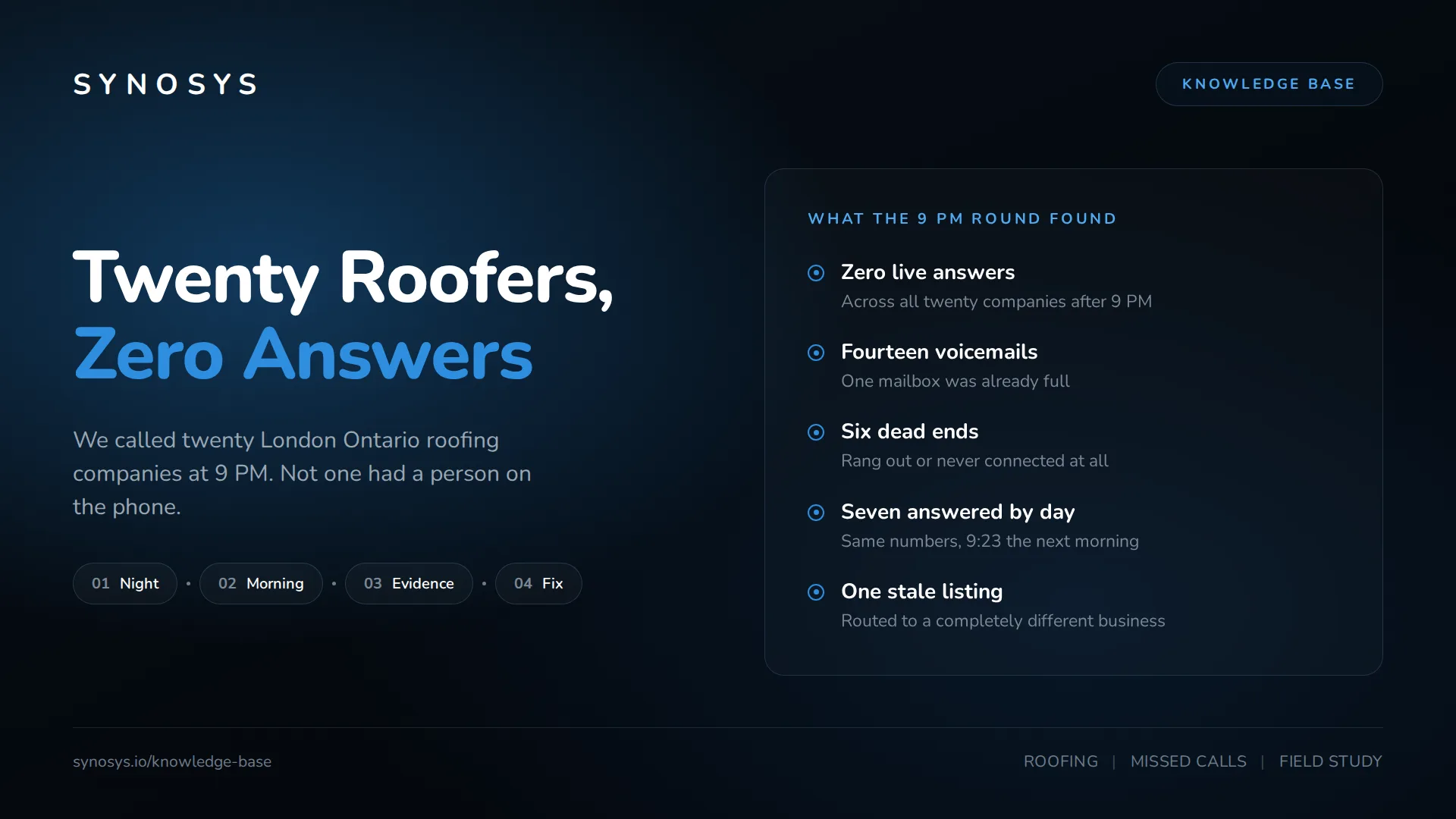
Poster titled Twenty Roofers, Zero Answers, summarising a 9 PM call test of 20 London Ontario roofing companies.
It is 9 PM on a weeknight. There is water coming through a bedroom ceiling in London, Ontario, and it is getting worse. The homeowner picks up a phone and starts looking for a roofer.
We wanted to know what happens next. So we became that homeowner.
We called 20 roofing companies in London at about 9 PM. Not one answered. 14 went straight to voicemail. 6 never connected at all.
The next morning at 9:23 we called 19 of the same numbers back. 7 answered.
That second round is the important one, because it kills the easy explanation. The phones are not broken. The numbers are not dead. The lines work. Nobody was on them at night.
The call you least want to miss
Nobody shops for a roof at 9 PM.
A call at that hour is not someone gathering three quotes for a job next spring. It is a leak, or a branch through the shingles, or something that was fine at dinner and is not fine now. The caller is not weighing your warranty against the company down the road. They are trying to make it stop before it reaches the drywall, the insulation and the floor below, because water damage gets more expensive every hour it runs.
That is the highest intent call a roofing company gets all week. It is also the one most likely to reach a machine.
Our own test proved the second half of that by accident. We did not call one company and give up. We worked down a list of 20, one after another, which is exactly what a person standing under a wet ceiling does. They do not leave a message and go to bed. They dial the next number. Then the next one.
Whoever picks up first is not competing on price in that moment. They are the only one in the conversation.
What we heard on the lines
A tally hides the texture. Four things stood out.
One voicemail greeting was a person's first and last name. No business name anywhere in it. A homeowner who called at 9 PM had no way of knowing they had reached a roofer.
One mailbox was full. There was no way to leave a message even for someone who wanted to.
One company answered with a phone menu offering office locations. At nine at night, to someone with an active leak.
One number reached a completely different business. A person answered, but it was a window and door company. That listing has been stale a while, and every homeowner who calls it is a lead that never even arrives.
We are not naming any of the 20. This was a survey of a market, not a report card on individual businesses. Any owner reading this can check their own line for all four in five minutes.
What we cannot tell you
We cannot tell you what those 14 voicemails cost.
The obvious next move is to multiply. 14 missed calls, some percentage who never leave a message, an average job value, and out comes a frightening annual number. Everyone in our industry publishes that number. We went looking for the input and the input does not hold up.
Ask how many callers leave a voicemail and you will be told 20 percent. You will also be told 33, 67, 80 and 90 percent, on pages that are all confident and none of which agree with each other. We traced the most common version, an 80 to 90 percent hang up rate credited to Hiya's State of the Call report, back to the report itself. That statistic is not in it.
The roofing specific lists are the same. One competitor's post offers 15 numbers, including $2,500 as the average cost of a missed call, each credited to an industry report with a convincing name and no link. We could not verify one of them.
So we are not going to add a sixteenth. What we can say is smaller and firmer. On one night, in one city, 20 roofing companies had nobody answering the phone, and the next morning 7 of them did. Whatever a 9 PM call is worth, none of them found out.
An empty lane
Now turn the finding around.
If 14 of 20 go to a machine at 9 PM, then answering at 9 PM is not a premium feature in this market. It is an empty lane.
Most differentiation in roofing is expensive and slow. Better materials, longer warranties, more reviews, nicer trucks. Being the one who answers costs a fraction of any of that, and on a weeknight it is the only difference the caller can actually detect. Everything else on your website is invisible to someone holding a bucket.
That does not make it easy. Staying reachable is the entire problem, and it is why 14 of 20 are not.
Three ways to fix it
They are not equally useful. Be honest about which one you are on.
From cheapest to most reliable
Fix the greeting
Free and takes ten minutes. State your business name in the first five seconds, give a callback window, and make sure the mailbox has room in it.
Put someone on call
A rota and a forwarded line so a real person picks up. Some companies run this well. It costs somebody their evening, every evening, and it degrades quietly.
Answer, qualify and route
A voice agent picks up on the first ring at any hour, establishes whether this is an active leak or a quote for April, takes the address and callback number, then wakes the on call person for a real emergency and books everything else for the morning.
The point is not that a machine handles the job. The point is where the lead stops leaking. The first level captures a message. The second captures it faster. The third keeps the caller from dialling the next number on their list.
Find out which level you are on
It takes ten minutes and costs nothing.
Borrow a phone your office will not recognise. Call your main line at 9 PM on a weeknight and let it ring the full cycle. Write down exactly what happened, not what you assumed happens. Then listen to your own greeting all the way through. Does it say your company name. Does it give a callback window. Is the box even accepting messages.
Do it again at 7 AM, at noon on a Saturday, and during your busiest weekday hour, when calls stack up behind the ones you are already on.
Most owners are surprised by what they hear. The greeting was recorded years ago by someone who has since left, or it was never recorded at all and the carrier is reading your own phone number back to your customers.
If the test says nobody is there at 9 PM, fix the greeting today. It is free and you can do it before you finish reading this.
If it says real jobs are ringing out, that is when a conversation about live intake is worth having.
Get this run on your own market
We will run the same 30 number audit on your market at no charge and hand you the spreadsheet either way.
Book a free intake audit