
Week of August 24: Five Decisions, Two That Should Not Have Reached Me
Five decisions landed on my desk this week and I cleared all five. Two of them were never mine to make. Here is what that told us about the way our tasks are written.
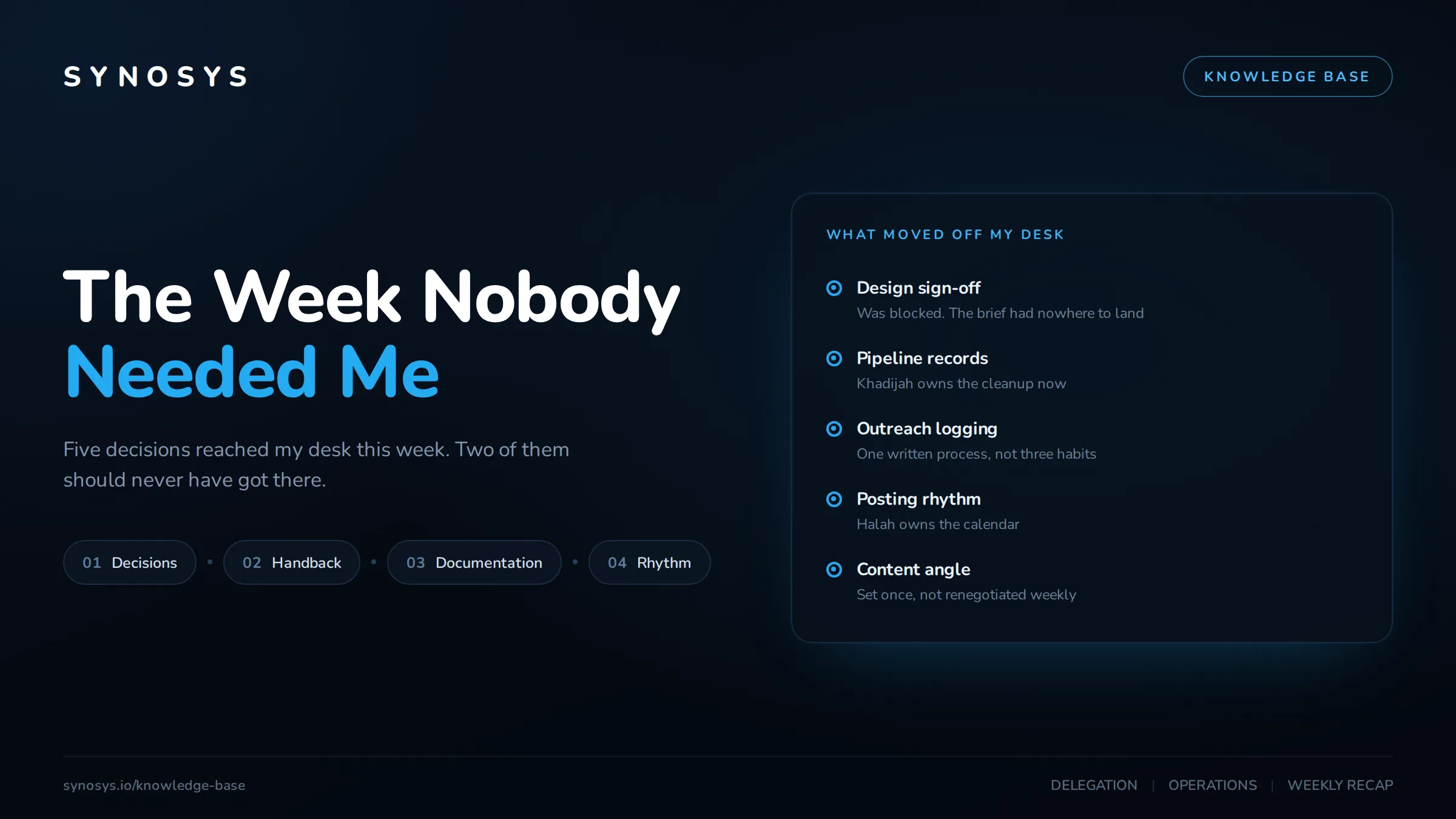
Five decisions in. Two handed back.
Shipped
Five decisions came off the Needs-Ali queue. Two of them went back to the people who actually own those areas.
A documentation session with Halah and Khadijah, so outreach logging is one written process instead of three personal habits.
Khadijah backfilled the week's outreach into Client Interactions and fixed duplicate lead records that had been quietly splitting contact history across two rows.
Mohammed came off design and started building the outreach automation platform.
The posting rhythm got locked and written down. Which article goes out on which day, which platforms each video hits, who owns each slot, and what happens on a week when a client call blows the schedule up.
The process video went out on LinkedIn, X and YouTube.
Learned
The two decisions I handed back are the interesting part.
Neither was a hard call. Neither needed me specifically. They reached my desk because nothing anywhere said who else could make them, and a decision with no name on it rolls uphill by default. That is not delegation failing. That is delegation never having been written down in the first place.
We got a clean example of the same problem earlier in the week. A design brief was marked done, and the work genuinely had been done. But the brief sat on a branch and never landed anywhere I could open it, so the sign-off it was blocking simply stopped. Nobody cut a corner. The task said what to produce. It never said where to put it.
Both failures were quiet. Neither showed up as a missed deadline or an angry message. They showed up as things sitting still, which is the hardest kind of problem to notice from the inside.
Next
Three changes, all small.
Done now means the output exists somewhere the next person can open it. Not that the work happened.
Decisions get an owner before they get a deadline.
And the number I am watching next week is not how fast I clear my queue. It is how few things reach it at all.
The same thing happens on your phone line
Most of the businesses we work with have this exact problem, just pointed outward. Nobody owns the call that comes in after five, so it defaults to nobody, and it shows up as a quiet week rather than a visible failure.
Finding out
where your calls actually go is part of our free intake audit, and we will map it whether or not you work with us.
Book an audit