
Won't People Just Hang Up on an AI?
It's the most common question we hear. The data says people don't hang up on AI. They hang up on bad experiences. Here's the difference, with numbers.
Almost every business owner we talk to asks the same question at some point: "Won't people just hang up when they realize it's an AI?" It's a fair question. Nobody wants to put something between their customers and their business that pushes people away. So instead of giving you our opinion, we'll walk through what the data actually shows.
Start With What People Hang Up On Today
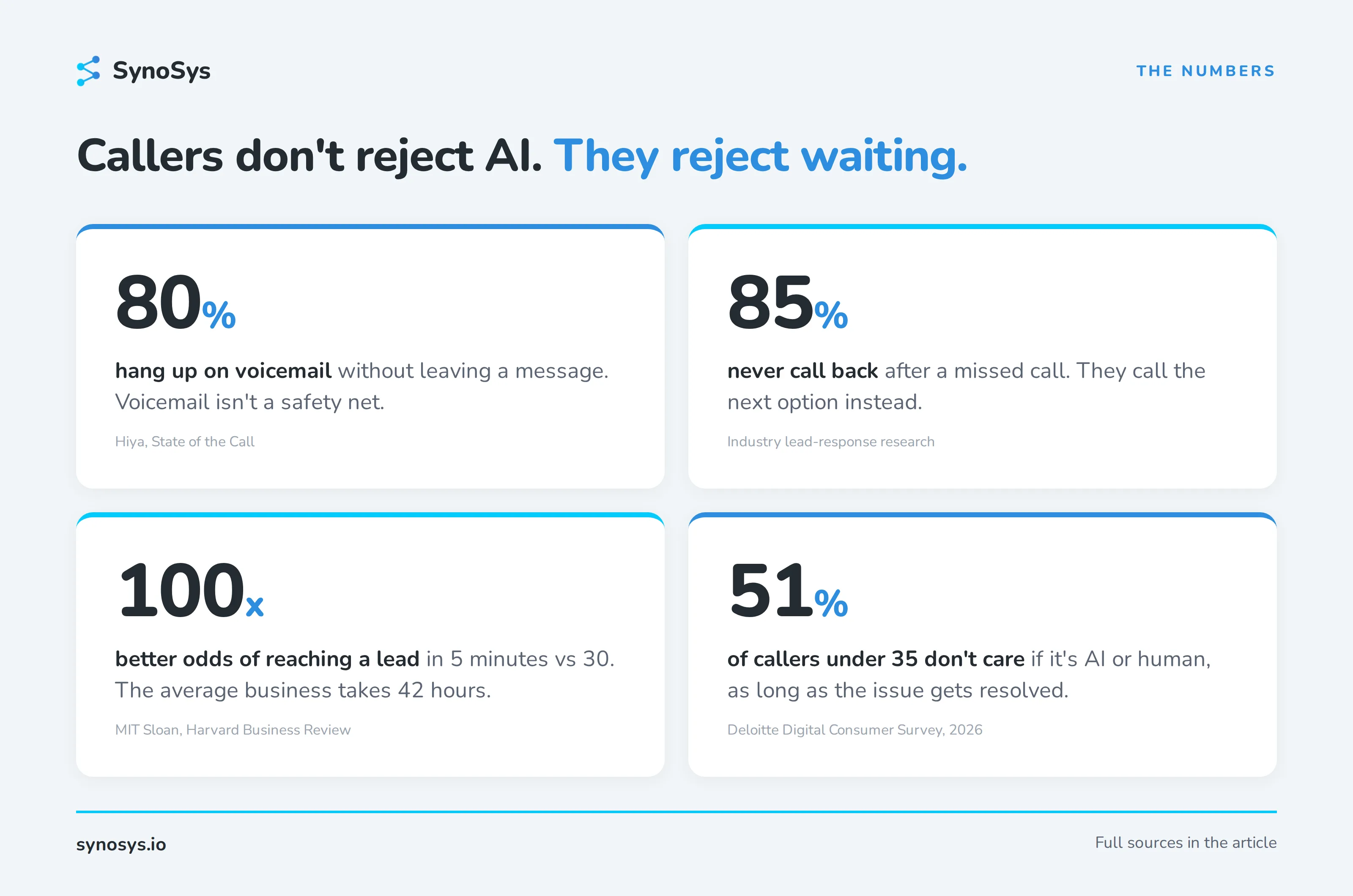
Before asking whether people hang up on AI, ask what they hang up on right now. The answer is voicemail. Roughly 80% of callers who reach a business voicemail hang up without leaving a message, based on data from Hiya's State of the Call research, and about 85% of callers who don't get through never call back at all. Voicemail isn't a safety net. It's where your leads quietly disappear.
Speed makes it worse. The well-known MIT Sloan lead response study found that your odds of reaching a lead drop about 100 times when you wait 30 minutes instead of 5. A Harvard Business Review audit of over 2,200 companies found the average business takes 42 hours to respond to a lead, and responding within the first hour made companies nearly 7 times more likely to qualify it. The person who called you at 7pm and got voicemail is not the same lead at 9am tomorrow. They're usually someone else's customer by then.
So Do People Actually Talk to AI?
Yes, and increasingly without caring that it's AI. A 2026 Deloitte Digital consumer survey found that 51% of consumers aged 18 to 34 have no preference between AI and a human on the phone, as long as their issue gets resolved. Zendesk's CX research puts it more broadly: 81% of consumers now see AI as a normal part of modern customer service, and 61% prefer self-service for simple issues like booking, rescheduling, and basic questions. Those simple issues are exactly what most inbound calls are.
Here's the part most people get wrong about younger callers. Research covered by McKinsey found that 71% of Gen Z consumers actually favor phone support. They don't hate the phone. They hate voicemail. They want a real-time answer, and they don't care much whether it comes from a person or a well-built AI. The phone call is still their preferred channel. The dead end at the other side is what drives them away.
Some People Do Prefer Humans
We're not going to pretend the data is one-sided. A 2025 SurveyMonkey study found that many consumers still prefer human agents for complex problems, mainly because they feel humans understand their needs better. That's real, and it matters. But look at what that preference is actually about: complex, emotional, high-stakes conversations. Nobody is asking an AI to handle a billing dispute or deliver difficult news. The job of a voice agent is the other 80% of calls: What are your hours? Can I book Tuesday? Is the doctor taking new patients? I need to reschedule.
The Real Comparison
The question "will people hang up on an AI?" quietly assumes the alternative is a friendly human answering every call. For most clinics, law firms, and real estate teams, that's not the alternative. The alternative is a front desk juggling three things at once, a lunch hour with no coverage, and voicemail every evening and weekend. When you compare an AI agent to a great receptionist who answers instantly 24/7, the human wins. That receptionist doesn't exist. The fair comparison is AI versus voicemail, and voicemail loses 80% of the time before the beep.
What Callers Actually Reject
Put it all together and the pattern is clear. Callers reject waiting. They reject hold music and phone trees. They reject leaving a message into the void and hoping someone calls back. And satisfaction data backs this up: AI voice agents score nearly double the satisfaction of legacy phone menu systems, because they answer instantly and actually resolve things. People don't hang up because it's AI. They hang up because nothing happened. Make something happen in the first ring, and they stay on the line.
So the next time you catch yourself asking "will people talk to an AI?", flip the question. What's happening to the people calling you right now when nobody picks up? That number is measurable, it's larger than you think, and it's the one worth fixing first.
Sources
Missed call and voicemail abandonment data: https://www.futurocorp.com/blogs/missed-call-economics
Speed-to-lead research (MIT Sloan, HBR, sourced and year-stamped): https://callforce.global/blog/cost-of-missed-calls-and-slow-lead-response-2026/
Deloitte 18-34 AI preference stat and AI vs IVR satisfaction scores: https://ainora.lt/blog/voice-ai-statistics-market-data-2026
Zendesk and Salesforce consumer AI acceptance stats: https://www.cloudtalk.io/blog/ai-voice-agent-statistics/
Gen Z phone preference (McKinsey survey coverage): https://oncallclerk.com/blog/why-callers-dont-leave-voicemail
Consumer preference for humans on complex issues: https://www.surveymonkey.com/curiosity/customer-service-statistics/