
What Happens to a Roofing Call When Nobody Can Pick Up
An AI receptionist answers, checks your calendar and books the job while you are still on the roof. How it works, where it falls short, and a free test for your own phone line.
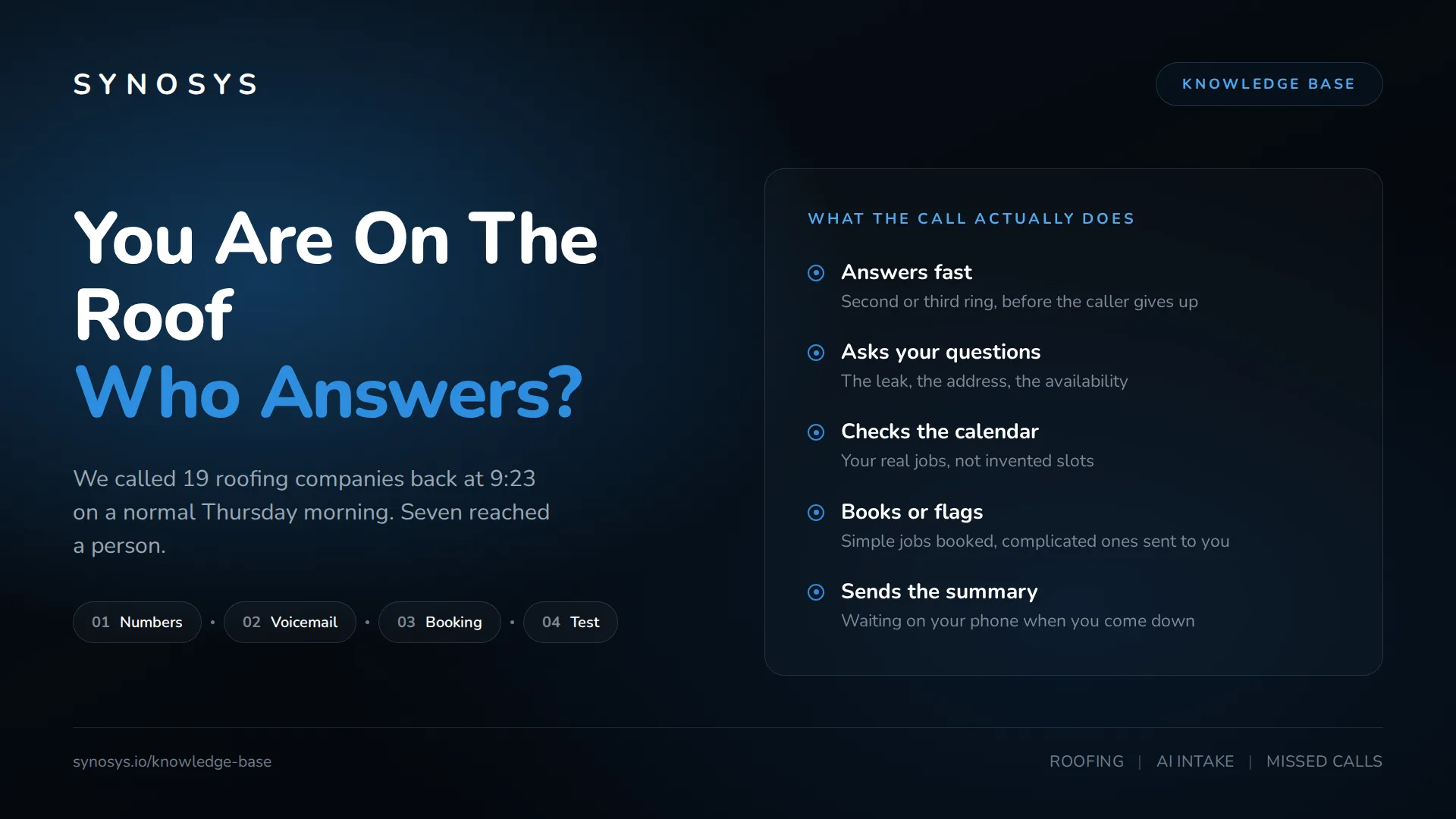
You are on a roof. Your phone is in the truck, in your pocket under a harness, or ringing while both your hands are full. Somebody calls with a leak. You cannot pick up.
An AI receptionist answers instead. It talks to the caller like a real receptionist would. It asks what the problem is, where they are, and when they are free. It checks your calendar, finds an open slot, and books it. Then it sends you a summary.
You come down off the roof, check your phone, and the job is already booked. That is the whole idea. Here is how it works, where it falls short, and a simple test you can run on your own phone line today.
The reality of missed calls
In August we called 20 roofing companies in London, Ontario at about 9 PM. Not one answered. Fourteen went to voicemail, and six did not connect at all. It was 9 at night, so that is no surprise. We wrote that round up in full in We Called 20 Roofing Companies at 9 PM.
We called 19 of them back the next morning at 9:23 AM on a normal Thursday. Seven reached a person. Twelve did not. One picked up as a completely different business.
The leak is not just happening after hours. It happens at nine in the morning on a working day because the owner is up a ladder and nobody else is holding the phone.
We will not guess what a missed call costs you. You already know what one roof job is worth. Multiply that by twelve and do the math yourself.
Where the obvious solutions fail
Answering services and standard voicemails both have the same flaw. They take a message, but they do not book anything.
A homeowner with water coming through the ceiling will not wait. They call the next roofer on the list while your voicemail is still playing. A message you read four hours later is a message about a job someone else already took.
The goal is not just answering the phone. The goal is ending the call with an appointment on your schedule.
It also should not try to handle everything. Insurance claims, angry customers, and questions about a job from two years ago belong with you. A good setup books the straightforward jobs, which is most of them, and flags the rest so you can follow up with the full picture.
How the process works
The whole sequence takes about ninety seconds.
From ring to booked
The call comes in
It rings your normal business number. You forward your line to the agent or route the number straight to it.
It answers fast
Second or third ring. A caller who sits through six rings has already decided you are not around.
It asks your questions
What is wrong, is water coming in right now, the address, residential or commercial, and when they are available. You write these once and it asks them every time.
It checks the calendar
Your real calendar with your real jobs in it, so the slot it offers is a slot you can actually work.
It books or it flags
If the job fits, it goes on the calendar and the caller gets a confirmation. If it does not fit, it takes the details and marks it for you.
You get the summary
A text or an email with who called, what they need and what got booked. That is what you read when you come down.
A free test for your own line
Do not hire anybody yet. Run this first, because you might find out your phone is fine.
Four calls, thirty seconds each
Borrow a phone
Use a number your business does not recognize. Call your line at 10 in the morning on a Tuesday. Count the rings and time how long it takes for a person to speak.
Check your greeting
Listen to your voicemail all the way through. Does it say the name of your company? Several of the voicemails we reached never did. A homeowner calling four roofers hangs up on a greeting that does not tell them who they called.
Try the evening
Call again at 8 PM, when a homeowner has finished work and is finally looking at the ceiling stain.
Try Saturday morning
That is when people actually deal with their houses.
Now you have four numbers. That is your real answer rate, measured rather than guessed. If a person picks up every time, you do not have this problem and you can stop reading. If they do not, you know exactly how big the hole is.
Hear one before you decide anything
If you want to know what this sounds like instead of reading about it, call 226-271-4989.
That is our own line, so it answers as the Synosys receptionist rather than a roofing one. You will still hear the thing that matters, which is whether it holds a real conversation, understands what you are asking, and gets to a booking without sounding like a phone menu.
Ask it questions. Try to trip it up. It takes about two minutes and nobody follows up with you unless you ask them to.
That is the honest version of a sales pitch. Go and hear it, then decide whether it is any good.