
Is AI Worth It Long Term? Think Like an Investor, Not a Buyer
Owners judge AI on a three month trial and a monthly invoice. Investors ask what it owns in three years and what it costs to not hold it. Here is the difference, with the math.
The answer, before the argument
Whether AI is worth it long term depends on how you buy it, far more than on which tool you pick. Two roofing companies can run the same system and get opposite results. One of them wrote down a number before they started. The other one did not.
A buyer asks one question. What does this cost per month.
An investor asks two. What will this own for me in three years, and what is it costing me every month that I do not have it running.
The second question is the one almost nobody runs. It is also the one that changes the decision.
Run the second question on your own numbers
In August we called 20 roofing companies in our area at 9 PM. Not one of them answered. We wrote up what happened in We Called 20 Roofing Companies at 9 PM. None of those owners think they have a problem, because a call that never connects never shows up anywhere they look.
Here is how you price that for your own business. You need three numbers you already have.
- What one closed job is worth to you, on average.
- How many of the people who reach you turn into a job.
- How many calls you missed last month.
Then cut it in half, because not every missed call was a real customer.
An example with made up numbers. A job is worth 6,000 dollars. You close one in five of the leads that reach you. You missed 12 calls last month. Halve that to 6 real leads. Six leads at a one in five close rate at 6,000 dollars is 7,200 dollars a month. Call it 86,000 dollars a year, and you have already been generous to yourself twice.
Now put whatever an intake system costs you next to that number instead of next to zero. The question stops being whether you can afford it. It becomes how much of that gap you are willing to keep paying while you think about it. That is the calculation we walk through in The Real Cost of a Missed Call.
Why most pilots fail
Most AI projects do not pay off.
MIT's NANDA initiative published a study called The GenAI Divide: State of AI in Business 2025. Around 95 percent of the generative AI pilots they looked at produced no measurable impact on the business. That work was based on 150 interviews with business leaders, a survey of 350 employees, and a review of 300 public deployments. It looked at large companies, not roofing companies, so read it as a warning and not as your own odds.
The reason matters more than the number. The failures were not about the technology being bad. They were about the gap between a tool that demos well and a daily process that actually changed.
The same study found something else, and I am a vendor, so weigh it with that in mind. Buying from a specialised vendor worked roughly 67 percent of the time. Building it in-house worked roughly 33 percent of the time.
Put those two findings together and you get the real investor read. The asset is real. The failure rate is high. And the thing that decides which side you land on is process, not product.
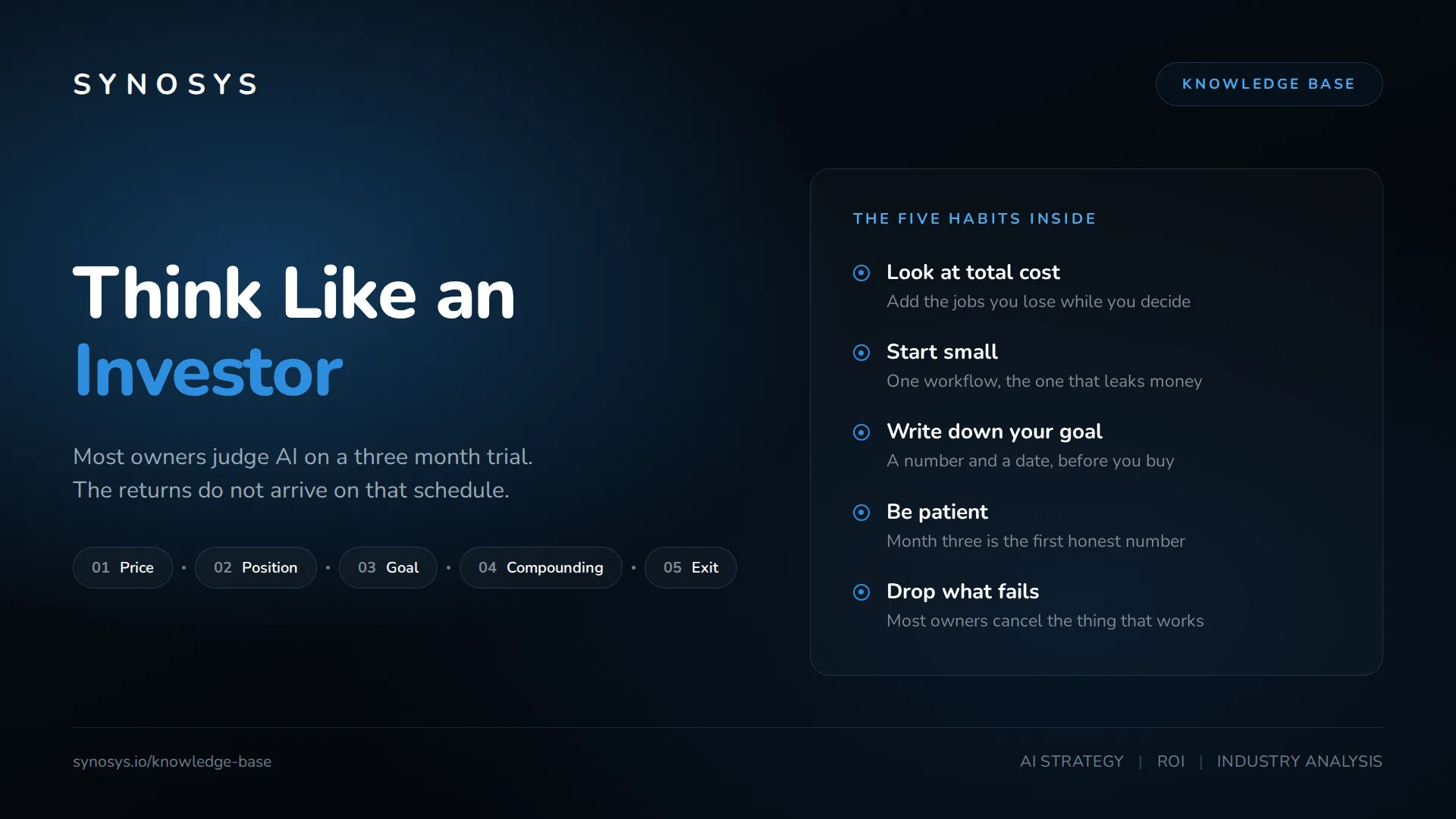
Five habits for higher returns
How an investor would buy this
Look at total cost
The monthly fee is the price. The rest is what you lose by waiting.
Start small
One workflow, the one that leaks money. Not the whole front office in month one.
Write down your goal
One page. The workflow, the number that proves it worked, and the date you check it.
Be patient
Month one is setup. Month two is fixing what the transcripts show you. Month three is the first honest number.
Drop what fails
Most owners do the opposite. They cancel the slow thing that works and keep the fun thing that does not.
What actually compounds
This is the part that makes it an investment instead of a tool, and it is the part most articles miss.
The model is not your asset. It gets better every few months, and every one of your competitors gets the same upgrade on the same day. Nobody has an edge there.
Your asset is what the system captures while it runs.
- Every call transcribed, so you learn the objections people actually say, not the ones you remember.
- Every lead in one place with its source attached, so you finally know which marketing is working.
- Your intake questions written down as a process, so the answer does not change when someone is off sick.
- A clean record of response times you can put in front of a lender, a partner, or a buyer.
None of that exists in month one. All of it is worth more in year three than it was in year one. A subscription is worth exactly the same in year three as it was on day one. That is the whole difference between an expense and an asset.
What to do today, without hiring anybody
One page, three lines. It takes about twenty minutes.
Line one, the baseline. Pull last month's call log from your phone provider. Count two things: calls shorter than 15 seconds, and calls that came in outside your working hours. That is your baseline. You cannot measure a return without one, and this is the step almost everyone skips.
Line two, the goal. Write one sentence in this shape. "This works if we book six more jobs a month by December 1." A number and a date. If you cannot write the number, you are not ready to buy yet, and finding that out for free is worth the twenty minutes on its own.
Line three, the target. Pick the single workflow that leaks the most money and leave everything else alone. What to Automate First, and What to Leave Alone covers how to choose.
Do those three lines and you are already ahead of most of the companies in that MIT study, and you have not spent anything.
Want line one done for you?
We run a free intake audit. We look at where your calls actually go, what is being missed, and what it is worth. You get the numbers whether you work with us or not.
Book the free intake auditSources
- MIT NANDA, The GenAI Divide: State of AI in Business 2025, reported by Fortune
- Synosys after hours call test, August 2026, We Called 20 Roofing Companies at 9 PM